
What is Tonight
The personalized evening ritual that helps your mind believe the day is over.
Tonight is not another meditation app playing the same recording to everyone. It listens to what your particular evening is carrying — and builds a short ritual around exactly that.

What is Tonight?
Tonight is an app for the hours after the day is technically over but has not ended inside you. It turns the way you actually feel tonight into a spoken, personal wind-down — a few quiet minutes that help you set down what your mind is still holding.
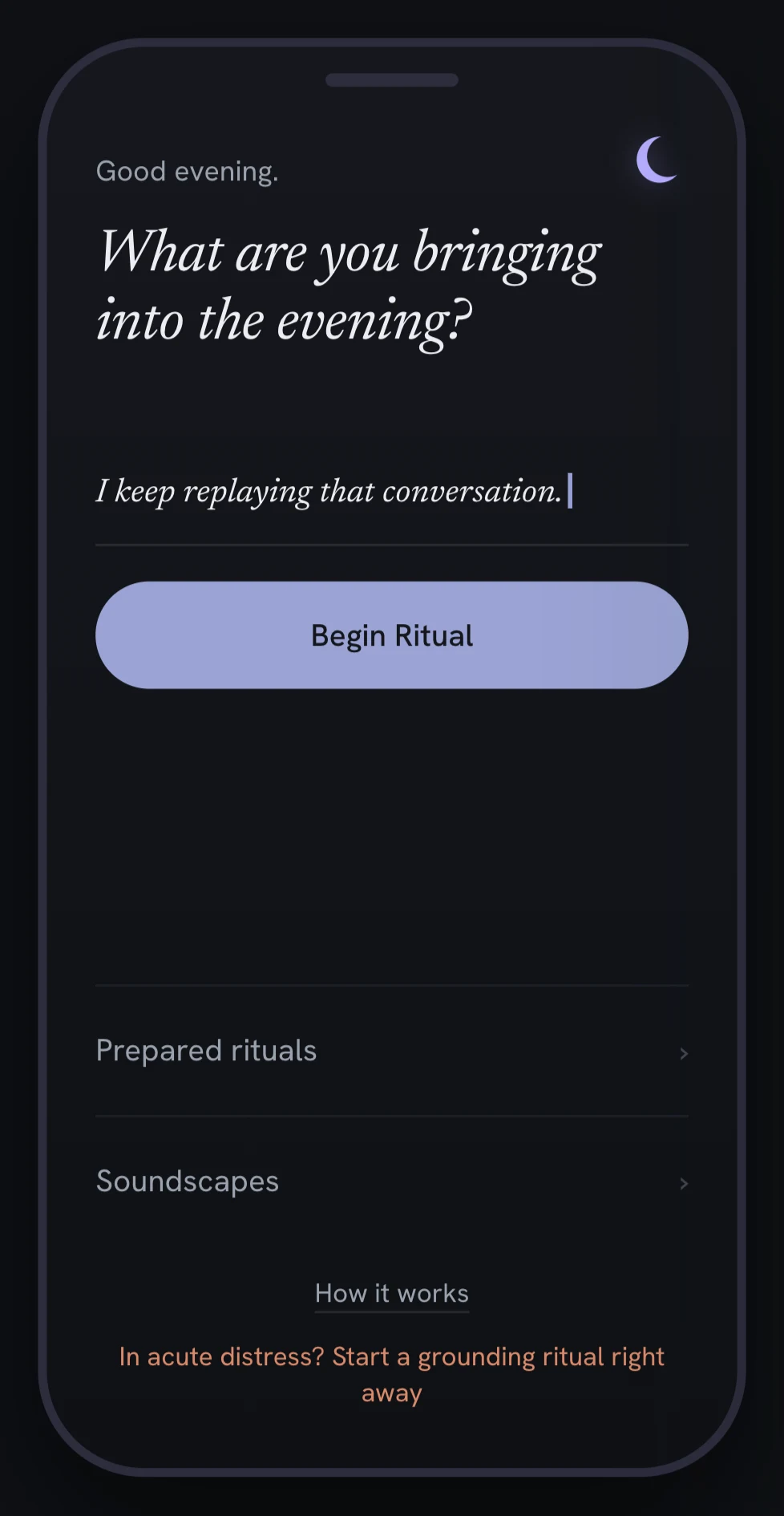
Where most sleep apps offer a fixed library, Tonight starts from a simple question: what are you bringing into the evening? The ritual is built from your answer.
How Tonight works
- 01You tell Tonight what the evening is holding — in a sentence, or by choosing what fits.
- 02Tonight composes a spoken ritual around it, in a voice you choose, over a soundscape made to settle you.
- 03You listen, set the thought down, and the day is allowed to end. Nothing to solve, nothing to perform.
Find your evening pattern
Why evenings feel different for different people
Two people can lie in the same dark and be kept awake by completely different things. The thought that will not settle has a shape. Once you can name it, it stops feeling like a personal failing and starts feeling like a pattern — one that has a gentler response than “try harder to sleep.”
Below are five of the most common. You can find yours in about a minute.
Pattern 01
Tomorrow’s Weight
The lights go out and tomorrow arrives early. Meetings, decisions, the things you must not forget — all of it pressing on a night that has barely started.
Anticipating the next day keeps responsibilities mentally active, especially when they have no trusted place outside your head. The mind is not trying to ruin your rest. It is trying to make sure nothing important is dropped.
It may not be asking you to solve tomorrow. It may be asking for proof that tomorrow has somewhere to go.
Name one thing and put it somewhere safe. Tomorrow can exist without living entirely inside your head tonight.
Pattern 02
The Replay
Part of you is still inside a conversation, a moment, a look on someone’s face — turning it over, testing different endings.
Social moments stay active because the mind keeps searching for a meaning or a response the moment itself never gave you. The replay is not proof that you must solve the relationship tonight.
Replaying it may be an attempt to find an ending that the moment itself never offered.
Let the moment rest here. You can care about what happened without rehearsing it for the rest of the night.
Pattern 03
The Open Task
Something practical still feels uncontained — an unfinished thing that keeps raising its hand in the dark.
A task is easier to release temporarily when the mind trusts it has been captured somewhere. This is not a productivity exercise, and you do not need a full plan. One clear sentence can give the unfinished thing a location outside the night.
An unfinished task can stay loud when it has no trusted next place.
Place it on tomorrow. The task can remain unfinished without remaining uncontained.
Pattern 04
Night Watch
It is less about one thought and more about a part of you that will not stand down — still scanning for what could be missed, needed, or unsafe.
Some evenings are not dominated by one obvious problem. The system simply has not received a clear signal that it is allowed to rest. Naming what it is watching for can soften the vagueness of that state, even when it does not vanish at once.
Sometimes the night feels hard because nothing has told the guard it may stand down.
Name what is keeping watch. You do not have to dismiss the alertness to meet it more gently.
Pattern 05
Everything at Once
No single loop is the loudest. Several things arrive together and compete for the same quiet space.
When many unfinished thoughts arrive at once, trying to organise all of them becomes another demand. Choosing one does not mean the others are unimportant — it creates a first point of contact with a night that otherwise feels shapeless.
You do not have to sort the whole night. One thought is enough.
Set down this one thing first. Relief does not require organising every thought before you rest.

Why it works
Unfinished things stay active in the mind — psychologists call it the Zeigarnik effect. During the day, noise and movement keep those open loops in the background. At night, when fewer things compete for attention, they rise. Naming one does not complete it; it tells the mind the thought has been noticed and can be returned to later.
Tonight is built on one belief: the day doesn’t end when the lights go out — it ends when your mind believes it’s safe to stop. Read more in our manifesto or the science behind it.
Download Tonight
A personalized evening ritual built around what you are carrying tonight.