

You love the person beside you. You would also very much like them to breathe more quietly.
Those two facts can coexist.
A sound that barely registered last week can become impossible to ignore on a tired or sensitive night. Once you start waiting for the next breath, snore, whistle, or shift, the pattern can take over your attention.
Being irritated by a sleep sound is not a verdict on your relationship. It is a sleep problem you can solve together.
There is one important medical exception: frequent loud snoring, breathing that repeatedly stops and starts, or gasping for air can be signs of sleep apnea. If you notice those patterns, encourage your partner to discuss them with a healthcare professional. The NHLBI overview of sleep-apnea symptoms explains what to look for. Not everyone who snores has sleep apnea.
When Your Partner's Breathing Keeps You Awake
You Do Not Need to Apologize for Needing Sleep
You may hesitate to mention the problem because breathing is not something your partner is doing at you. That is true. It is also true that repeated noise can keep you awake.
Treat it like any other shared-bedroom issue: temperature, mattress movement, light, alarms, or different bedtimes. No villain is required.
Notice What the Sound Actually Is
Is it ordinary breathing that you have become focused on? Soft snoring? Loud snoring? A whistle? Coughing? Gasping? Long pauses followed by a snort?
That distinction matters. Ordinary breathing noise may only need a sound-management solution. Repeated breathing pauses, gasping, or frequent loud snoring deserve medical attention because they can occur with sleep-disordered breathing.
Do Not Spend the Whole Night Proving You Can Tolerate It
If a simple change does not help, use another option. Earplugs. A fan. White or pink noise. A different pillow position. A temporary move to another room.
Protecting one night's sleep is not a referendum on the relationship.
Separate Sleep Is an Option, Not a Meaning
Some couples sleep separately occasionally or regularly because of snoring, shift work, temperature, movement, or different schedules. That choice can be practical rather than emotional.
If separate sleep improves both people's rest, judge it by the effect on your lives and relationship, not by an idealized picture of what a couple's bed is supposed to look like.
The Soft Ethics of Quiet
Talk About It When You Are Both Awake
The middle of the night is a poor time for a sensitive conversation. If possible, raise it the next day:
"I've been having trouble sleeping through the breathing sounds lately. I know you are not doing it deliberately. Can we try a few things together?"
That is clearer than silently building resentment.
Annoyance Is Information, Not a Moral Failure
You can be annoyed by a sound made by someone you love. The feeling does not need to be turned into guilt.
Ask what would actually help: less sound, more distance, a different position, medical evaluation for snoring, or simply one night of uninterrupted sleep.
Space Can Be Practical
Moving to another room can sometimes be the kindest choice available at 2 a.m. You do not have to stay awake in order to prove closeness.
Ask Without Blame
Keep the issue shared: "How can we make this easier?" rather than "How can you stop making this noise?"
If your partner snores, they may not know what happens while they are asleep. A short recording can sometimes be useful to show a clinician if they agree, but do not try to diagnose sleep apnea from an app or phone recording alone.
Building the Bubble
Reduce the Contrast
A quiet, irregular sound can stand out more than the same sound against gentle background noise. A fan or neutral soundscape may make breathing less prominent.

Use proper earplugs if they are comfortable and safe for you. Do not put loose cotton or other improvised objects into the ear canal.
Make the Useful Tools Easy to Reach
Keep earplugs, a sleep mask, fan controls, or headphones where you can reach them without turning on bright lights and searching the room.
The goal is not to create a symbolic sanctuary. It is to solve the sound problem with the least drama possible.
A Sensitive Night Does Not Need an Animal-Sentinel Story
Some studies examine startle responses under different lighting conditions, but that does not justify saying darkness makes the modern nervous system stand sentry for ancient predators.
If you notice every small sound on a difficult night, tiredness, attention, stress, or simple individual sound sensitivity may be enough of an explanation. For broader hypervigilance, see the science of hyper-vigilance.
Keep Closeness and Quiet as Separate Questions
You can create physical closeness before sleep and still use earplugs afterward. You can cuddle for ten minutes and then move apart. You can sleep in another room and reconnect in the morning.
There is no single correct arrangement.
When the Mind Turns the Dial
Sometimes the Sound Is Not the Whole Problem
If every sound feels unbearable, ask whether you were already wide awake before your partner started bothering you. Work worry, frustration about sleep, or general restlessness can make one repetitive sound especially hard to ignore.
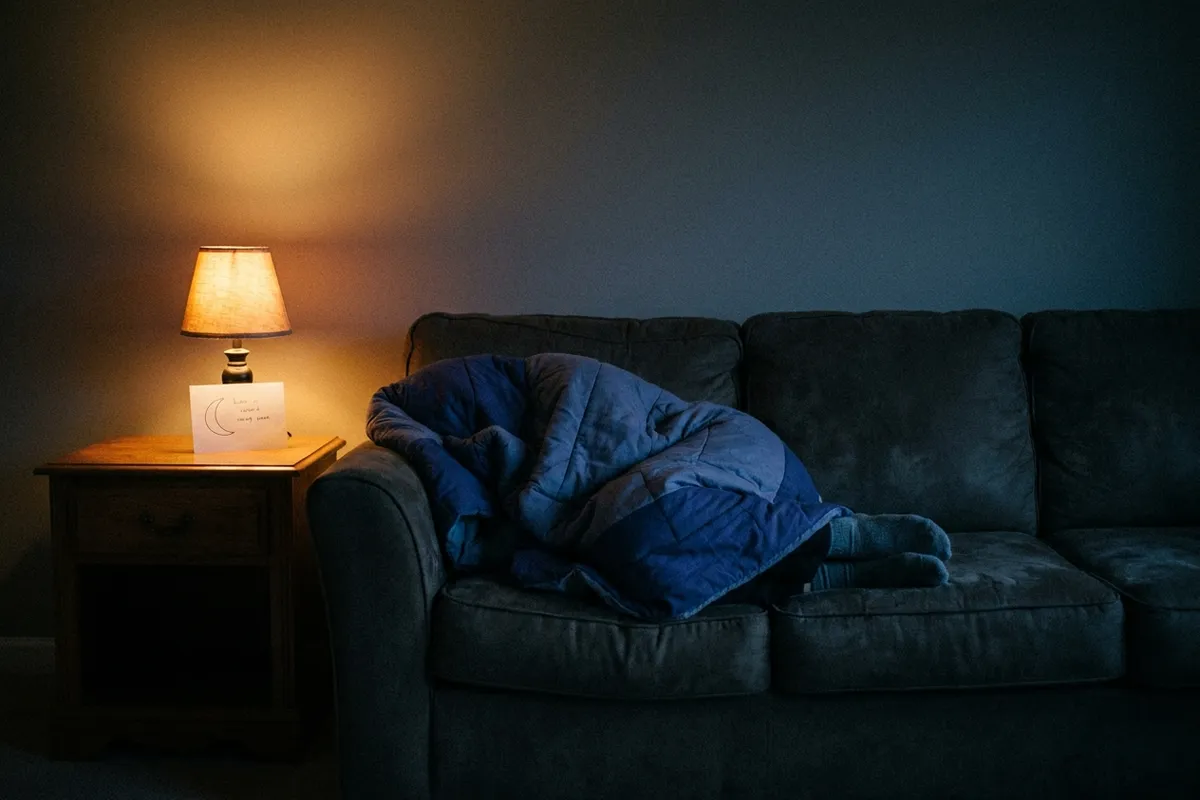
If Your Mind Is Already Racing
Why you can't shut your brain off at night may be more useful than trying to train yourself to love the sound.
Do not make your partner's breathing responsible for every awake minute if the larger problem is insomnia or worry.
Your Own Breathing Is Optional, Not a Counter-Rhythm
Slow breathing can be a comfortable relaxation exercise for some people. It does not need to synchronize with your partner's breathing, and it does not have to "harmonize" the two of you.
If breathing exercises make you more focused on sounds or bodily sensations, skip them.
A Small Move to Another Room
If you have been awake for a long time and another sleep space is available, moving can be the simplest answer. Discuss the option in advance so neither person has to interpret it as rejection at 3 a.m.
A Quiet Pact
Agree on the Options Before Bed
Decide together what is okay: waking the snoring partner, using a fan, trying a different position, leaving for the couch, using a second bedroom, or scheduling a medical appointment if the breathing pattern is concerning.

Keep the Practical Things Nearby
A spare blanket, earplugs, fan remote, or alternative sleep space can make the night easier. They are tools, not symbols of failure.
If You Are the Noisy Sleeper
Try not to hear your partner's sleep problem as a judgment of your body. If they report loud snoring, gasping, or breathing pauses, take the health information seriously rather than feeling blamed.
Ask the Simple Question
"How did you sleep?" can be useful if the answer is allowed to be honest.
Use Audio Only if It Solves the Right Problem
A neutral soundscape or guided audio may help mask a repetitive sound or give your attention somewhere else to go. Tonight can provide an AI-generated audio ritual, but it does not sit with you, keep you company, or understand the relationship problem.
The Light Behind the Curtain
Review the Solution in Daylight
In the morning, ask what actually worked. Earplugs? Fan? Separate room? Different position? Nothing?
Then make the next night easier before you are tired.
None of It Is a Verdict
Noise sensitivity, snoring, and different sleep needs can create friction without saying anything profound about the quality of a relationship.
Choose the Tool That Matches the Problem
If the issue is ordinary noise, use a noise solution. If it is persistent insomnia, consider evidence-based sleep help. If it is loud snoring with pauses or gasping, encourage medical evaluation. If you want a low-screen audio routine, you can download Tonight.
Frequently asked questions
Why does my partner's breathing keep me awake?
Repetitive sounds can become hard to ignore in a quiet room, especially when you are already tired, stressed, or focused on whether you will sleep. That does not mean your nervous system is standing sentry after dark. If the sound is actually frequent loud snoring, gasping, or breathing that stops and starts, encourage medical evaluation for possible sleep-disordered breathing.
Is it normal to be annoyed by your partner's breathing at night?
Yes. Being irritated by a sound does not mean you love your partner less. Treat it as a shared sleep problem rather than a moral problem: talk about it during the day, try practical sound changes, and leave room for either person to sleep separately when needed.
How can I sleep when my partner's breathing keeps me up?
Try proper earplugs, a fan or neutral background sound, a different pillow position, more distance in the bed, or another room if one is available. If you notice loud frequent snoring, breathing pauses, or gasping, do not only mask the sound — encourage your partner to discuss the pattern with a healthcare professional.
Should couples sleep in separate rooms because of noise?
Separate sleep is one practical option, either occasionally or regularly. It does not automatically mean a relationship is in trouble. The useful question is whether the arrangement helps both people sleep and whether the couple can discuss closeness and sleep needs openly.