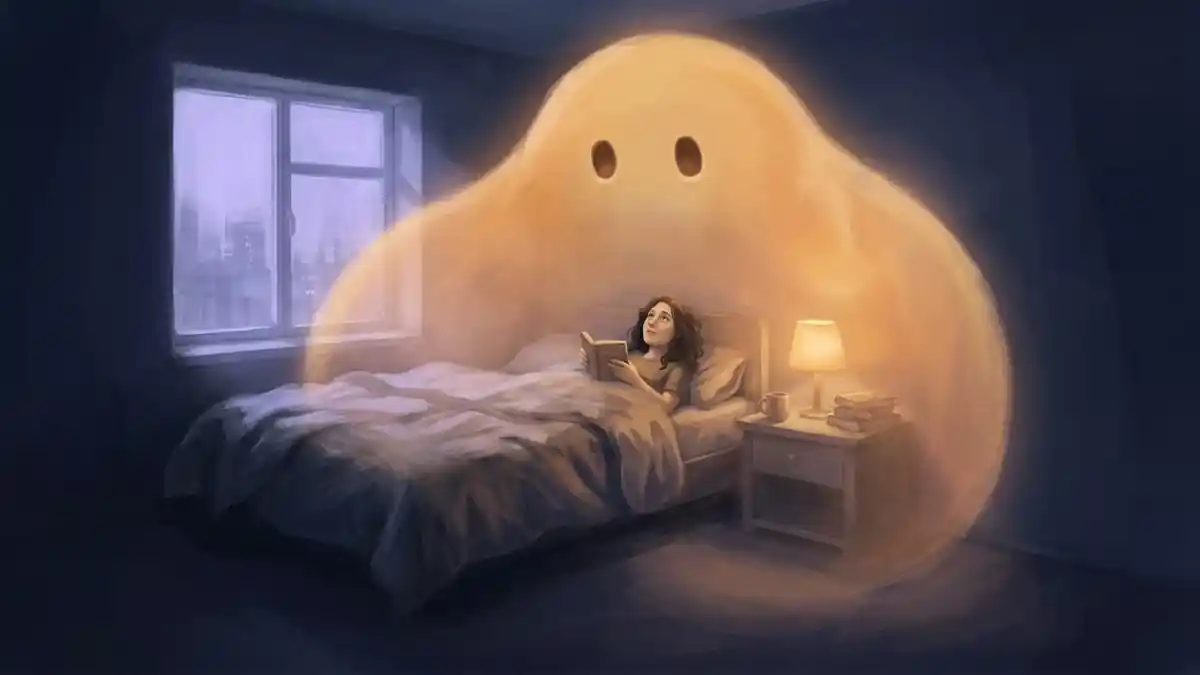

You wake and the room feels different from the room you went to sleep in.
Nothing dramatic has changed. The clock is glowing. A pipe clicks. The refrigerator starts and stops. Maybe there is a stripe of streetlight across the floor. But at 3 a.m., with no conversation, no daylight, and no obvious next task, ordinary things can feel strangely vivid.
That uncanny feeling of waking up at 3am is familiar to many people. It does not mean the hour itself is special or that something is wrong.
Sometimes you wake briefly and fall asleep again. Sometimes you are awake long enough to notice how unusual the world feels when almost everyone around you seems to be asleep.
You do not have to make the feeling mean anything. You can simply notice it, keep the lights low, and let the hour pass.
The Uncanny Feeling of Waking Up at 3am
The uncanny part is often how familiar everything is and how different it feels at the same time.
The kitchen is still the kitchen. The chair is where you left it. Your mug is on the counter. But without daylight and daytime noise, the room has fewer cues telling you what is supposed to happen next.
People Have Always Woken in the Night
People woke in the middle of the night long before digital clocks existed. Parents got up for children. Workers started before dawn. People prayed, tended fires, checked animals, used the bathroom, or simply woke and waited for sleep to return.
That does not prove that 3 a.m. has a special biological or spiritual meaning. It is simply a reminder that being awake in the small hours is not a uniquely modern failure.
The hour can feel strange without being a warning.
When Everything Feels More Noticeable
A distant car can sound unusually clear. The radiator seems louder. Your own breathing may feel more obvious. With fewer sounds and activities competing for attention, small details stand out.
That can make the room feel slightly unreal or dreamlike, especially if you woke suddenly from sleep. The feeling usually says more about the unusual context than about the objects around you.
Wolf Hour, Outside of Time
The phrase "wolf hour" has been used in art and popular culture for the deep-night period when sleep feels fragile and thoughts can become heavy. It is a poetic name, not a medical category.
When Time Feels Slow
Minutes can feel much longer when you are awake in the dark with nothing to do. Checking the clock often makes that worse because every glance turns the night into arithmetic: how long have I been awake, how many hours are left, how tired will I be tomorrow?
If you can, turn the clock away. You do not need to measure every minute of a waking.
You Do Not Need a Big Explanation
At 3 a.m., ordinary thoughts can feel more dramatic than they did in daylight. Tomorrow. Email. Money. Health. A conversation from yesterday.
You do not have to solve them now. A thought that arrives at 3 a.m. is still just a thought arriving at 3 a.m.
Why Familiar Rooms Feel Different at Night
The room does not remember you, listen to you, or change personality after dark. What changes is the context: less light, less activity, fewer voices, and often a mind that is half-awake and paying attention to details it normally ignores.
Nighttime Loneliness Has Its Own Texture
Being awake while other people seem to be asleep can feel lonely, even if you are not generally lonely. The quiet can make distance feel larger.
If that is familiar, we have a separate piece on why we feel lonelier after the sun goes down. You do not need to treat a lonely hour as proof that your relationships are failing.
Other People Are Awake Too
Even at 3 a.m., the world is not empty. Nurses are working. Drivers are on the road. Parents are feeding babies. Bakers are starting early shifts. Someone in another apartment may be standing at the sink too.
You do not have to imagine this as a mystical fellowship. Sometimes it is simply comforting to remember that a quiet street is not the same thing as an empty world.
A Brief Doorway for the Rationalists
If you wake around the same time repeatedly, there are ordinary explanations worth considering: sleep cycles, stress, alcohol, temperature, noise, pain, needing the bathroom, medications, insomnia, sleep apnea, or simply a pattern you have started noticing.
There is no universal "3 a.m. hormone event" that explains everyone. If you want the practical version, read why do you wake up at 3 AM every night.
You Can Let the Moment Be Ordinary
You do not have to turn the waking into a problem immediately. If you are comfortable and not distressed, you can stay quiet, keep the light low, and see whether sleep returns.
If you are wide awake for a while, get up and do something calm in dim light until you feel sleepy again rather than fighting with the bed.
Waking in the night can be ordinary. Repeated sleep disruption that affects your days deserves more attention.
Notice Without Studying Yourself
Maybe you drink some water. Maybe you sit for a few minutes. Maybe you notice rain against the window.
The point is not to turn the hour into another self-observation project. You do not need to catalog your pulse, decode every sensation, or decide what the night is trying to tell you.
The Art of Not Naming Everything
Not every difficult night needs a label. Sometimes you woke up. Sometimes you had a strange dream. Sometimes the room felt unfamiliar for a minute.
A small ritual can help without needing a mechanism behind it: put the phone down, take a sip of water, adjust the blanket, listen to a quiet sound, or read a few pages in low light.
The Night Can Still Be Beautiful
There is room for a little poetry here. Moonlight on the floor can be beautiful. Rain can sound different at night. A familiar street can look almost new.
You can enjoy that strangeness without claiming the house is breathing with you or that the hour has a message waiting inside it.
Stand Inside the Hour
If the waking is not frightening, try not to rush into fixing it. Keep things quiet. Avoid bright light and scrolling if you can. Let your attention rest on something simple.
If worry starts to grow, remind yourself that you can return to the problem in daylight. The middle of the night is rarely the best time to make a life decision.
Companions in the Dark
Sometimes another person is beside you. Sometimes you are alone. Sometimes a calm recording or sound gives you something gentle to focus on.
When You Want Something to Follow
Even with a partner breathing beside you, being awake can feel private. If you want human reassurance or conversation, a real person is the right source of that connection.
Tonight can play a different role. It is an AI-guided wellness ritual with carefully crafted voices. The audio can give you a simple sequence to follow without asking you to browse or decide what to do next. It is not a person, a presence, or someone listening in the dark.
An Ordinary Kind of Quiet
There can still be something special about hearing the world at an hour you normally miss: a distant train, a bird starting early, rain on the glass, a neighbor moving quietly upstairs.
And if none of that feels beautiful—if you are mostly frustrated, anxious, or exhausted—that is fine too. You do not have to romanticize being awake.
If repeated waking happens often, lasts for months, or leaves you struggling during the day, it is worth discussing with a healthcare professional. Loud snoring, breathing pauses or gasping, significant daytime sleepiness, pain, panic, or other concerning symptoms also deserve appropriate evaluation.
Eventually the night passes. You do not have to make 3 a.m. meaningful before morning arrives.
When the Day Lifts Its Face
In daylight, the kitchen looks ordinary again. That contrast is part of why the night felt strange.
You can remember the hour without turning it into a warning, a diagnosis, or a secret message. Sometimes the most accurate explanation is also the simplest: you woke up in a very quiet part of the night and noticed the world differently for a while.
Frequently asked questions
Why does waking up at 3am feel so uncanny?
At 3am there is often less light, noise, conversation, and activity, so familiar details can stand out in unusual ways. You may also have woken suddenly from a dream or deeper sleep and feel briefly disoriented. The feeling can be strange without meaning that 3am itself is dangerous or special.
What is the wolf hour?
"Wolf hour" is a poetic and cultural term for the deep-night period when people may feel especially awake, lonely, or unsettled. It is not a medical diagnosis and there is no single scientific definition that makes 3am a special biological threshold.
Is waking up at 3am a bad sign?
Brief nighttime awakenings can be normal. What matters more is how often you wake, how long you stay awake, what symptoms come with it, and whether your sleep is affecting daytime life. Persistent insomnia, loud snoring with breathing pauses or gasping, marked daytime sleepiness, pain, or other concerning symptoms are good reasons to seek medical advice.
What can I do when I wake up at 3am and feel strange?
Keep the environment quiet and dim, avoid clock-checking or scrolling if those make you more alert, and give sleep a chance to return. If you are clearly awake for a while, a calm activity out of bed can be easier than fighting for sleep. A recording or ritual may give you something simple to follow, but it is not human company or medical treatment.