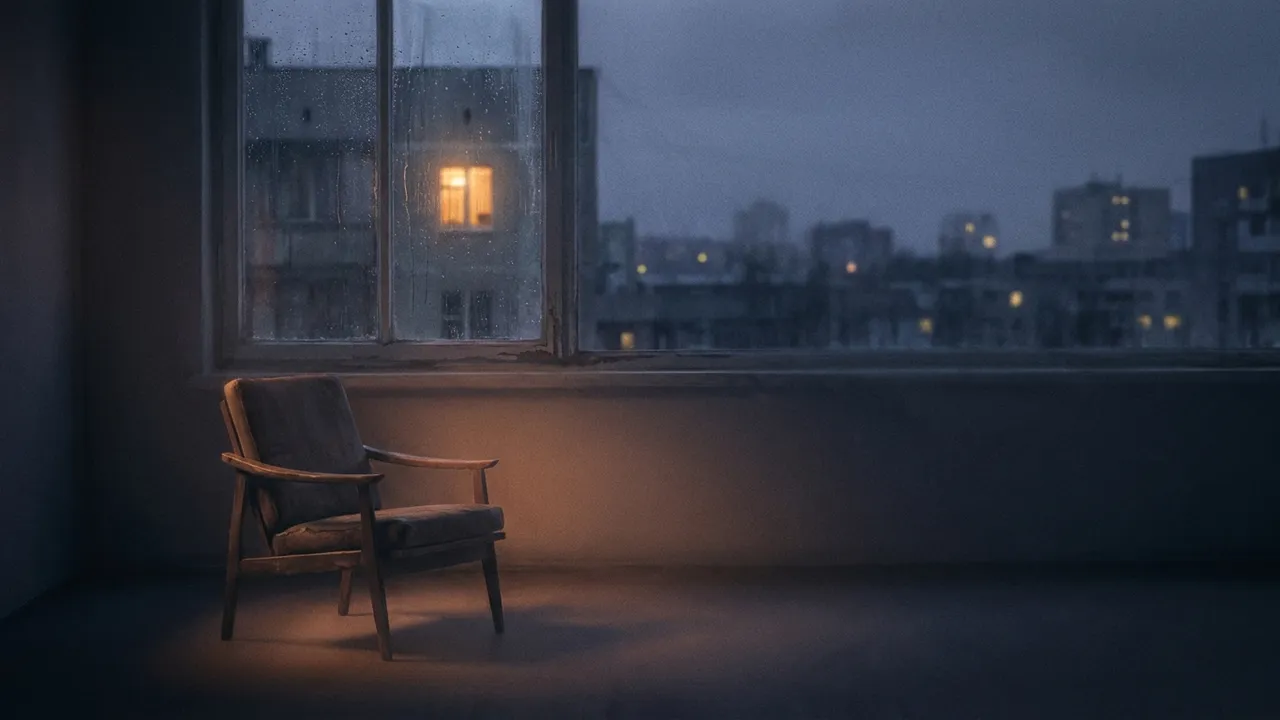
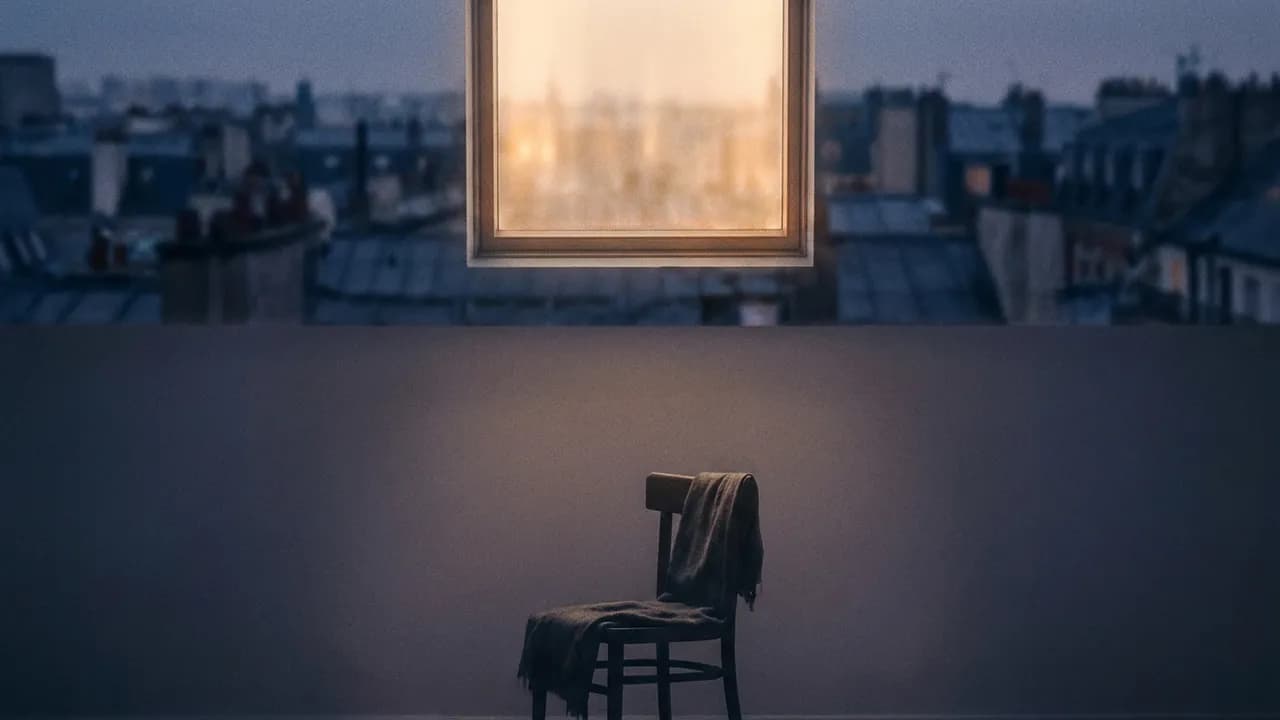
The room is dark. The day has put down its tools. No one needs you for a moment. The ceiling holds its plain shape above you, and then, without warning, the mind opens a trapdoor.
You are here. You are alive. You will not always be. Everyone you love is moving through time with you. The universe is enormous. Your body is small. The ordinary objects around you — the glass of water, the phone face-down, the shirt on the chair — seem suddenly lit by a strange and frightening truth.
To stop existential dread at night, try anchoring yourself in the present with the 5-4-3-2-1 grounding method.
This simple technique shifts attention away from overwhelming thoughts about life and death and toward your immediate senses. You softly name 5 things you can see, 4 you can feel, 3 you can hear, 2 you can smell, and 1 you can taste. It gives a spiraling mind a gentle, concrete task without asking you to solve the larger questions.
If you are there now, reading in the blue half-light, let this be the first handrail: a frightening thought does not need to be answered tonight.
Why Existential Dread Hits Hardest at Night
When the Mind Opens a Trapdoor
This is existential dread at night. How to stop it can feel impossible when the thought has already bloomed in your chest. It is not just worry. It is not exactly sadness. It can arrive as a fear of death at night, a cold wash through the ribs, a feeling of impending doom at night with no clear source. Sometimes it is anxiety about meaning of life at night, the aching question of whether anything you do is enough, or whether anything holds.
An Old and Very Public Fear
Existential anxiety is one name for this. It describes fear or unease around questions such as death, freedom, isolation, identity, and meaning. These are not small themes, and they are not unusual themes either. Philosophers, psychologists, artists, religions, and ordinary people have been wrestling with them for a very long time.
Nighttime existential dread can feel like a private emergency, but the questions themselves are deeply human. The same mind that worries about time and mortality also loves, remembers, imagines, grieves, makes soup, keeps promises, and reaches for another hand in the dark.
The goal tonight is not to defeat the questions. Some questions are too large to be wrestled into silence at midnight. The goal is gentler. You can come back to the room. You can come back to what you can see and feel. You can let the universe be large without trying to solve it from bed.
Why These Big Feelings Visit After Sunset
When the Handing Stops
By day, your attention is claimed in pieces. A kettle clicks. A message arrives. A dog barks behind a fence. There are errands, dishes, work, weather, the mild theatre of other people. Even when you are tired, the world keeps handing you objects to hold in the mind.
After sunset, the handing stops.
When there is less to do and fewer distractions, attention has more room to wander. Memory, self-reflection, unfinished worries, and big questions can become more noticeable. That does not mean the night has uncovered a deeper truth. It may simply mean there is less competing for your attention.
When Stillness Makes Thoughts Feel Louder
Tiredness can also change how manageable a thought feels. If you are overtired, hungry, lonely, grieving, stressed, or simply worn down, a question that felt philosophical at 3 p.m. can feel much harder at 1 a.m. Physical sensations such as a faster heartbeat or tight chest can add to the intensity.
This is one reason you may wonder, why do I get existential dread at night? The answer is not because the night is telling the truth and the day was lying. The quiet can remove some of the structure and distraction that usually keep larger questions in the background.
When Solitude Tips Into Cosmic Loneliness
There is a difference between solitude and loneliness. Solitude can be warm. It can sound like rain on the window, like your own breathing, like a book closing softly. Loneliness is sharper. It can make the same room feel abandoned by the world. When solitude tips into cosmic loneliness, the bed can feel less like a bed and more like a small raft moving through space.
Terror Management Theory is one psychological framework for studying how awareness of mortality may shape beliefs and behavior. The theory, developed by Greenberg, Pyszczynski, and Solomon, has generated a large research literature, but it is a framework rather than a complete explanation for why any one person feels existential dread at night. The original work is here.
There is nothing childish about being frightened by mortality or meaning. If your brain feels too awake to rest, you may also recognize the patterns described in When the Brain Is Too Active to Sleep: the body is tired, but the mind keeps striking matches.
The Danger of Getting Lost in the Cosmos
When One Question Pulls Another
Existential thought has a strange gravity. One question pulls another toward it. What happens after death? What was before birth? How can time move so quickly? What is consciousness? Why am I me and not someone else? What if nothing matters? What if everything matters so much that I cannot bear it?
Soon you are no longer lying in your room. You are nowhere. You are above the planet, below the earth, outside your own life, staring into abstractions with a racing heart.
This is the difficulty of cosmic dread before sleep. Not the questions themselves. Questions can make us kinder, more awake, more careful with one another. The problem is trying to solve infinity while exhausted.
A tired brain is not a good observatory for the universe.
When Abstract Thoughts Become Physical
Anxiety can show up physically. The chest tightens. The stomach drops. The skin prickles. Your heartbeat may feel more noticeable in a quiet room. Those sensations can then make the thoughts feel even more urgent, creating a loop between worry and physical discomfort.
You may feel untethered, as if your name, your address, your daily life, your favorite mug, your half-finished plans have all loosened. This is why grounding can be useful. Not as a way to deny reality, but as a way to shift attention toward what is actually around you now.
There is the vast reality: stars, time, death, mystery.
And there is the near reality: cotton against your ankle, the hum of the refrigerator, the weight of your shoulder on the mattress, the faint smell of laundry detergent, your own breath entering and leaving.
When you are spiraling, the near reality can be easier to hold.
Why You Can't Think Your Way Out
Trying to think your way out of existential anxiety can sometimes pull you deeper in. The mind says, one more answer, one more article, one more theory, one more late-night search. At that point, a concrete sensory task may be more useful than another argument.
If this spiral often comes with the sense that you cannot shut the mental machinery down, you may find comfort in Why You Can't Shut Your Brain Off at Night. You do not have to settle every question before you rest.
Tonight, you do not need to win an argument with existence. You can come back to earth.
A Lifeline for Your Mind: The 5-4-3-2-1 Grounding Method
A Rope You Can Find With Your Eyes Closed
Grounding techniques are deliberately simple. In the middle of a spiral, a complicated philosophy is usually the last thing you need.
The 5-4-3-2-1 method is one option. It uses the five senses to bring attention away from abstract fear and back into the immediate world. Name five things you can see. Four things you can feel. Three things you can hear. Two things you can smell. One thing you can taste.
This method does not require belief. It does not ask you to be calm before you begin. It does not ask you to stop thinking by force. Instead, it gives your attention a task that is concrete enough to hold.
That is all.
Of course, "all" can be a lot when the chest is loud. So take it slowly. The purpose is not to perform mindfulness correctly. It is simply to give yourself something immediate and specific to notice.
A Pause, Not a Cure
Grounding does not answer what happens after death. It does not settle every question about meaning, and it is not a treatment for every form of anxiety. It is simply a way to redirect attention when a thought spiral feels too large to manage in the moment.
Think of the technique as a pause rather than a cure. The lamp is still there. The sheet is still soft. The floor is still holding the bed. The world has edges again.
There is mercy in the small. A shadow. A seam. A breath.
Giving the Feeling a Boundary
You might also give the feeling a place and a shape rather than letting it fill the whole night. You can say, silently: this is existential fear. It is here right now. I do not have to follow it everywhere. For the next five minutes, I will stay with this practice.
A boundary does not deny the feeling. It simply keeps one difficult thought from becoming the entire room.
How to Come Back to Earth, One Sense at a Time
Move Through the Method, Slowly
Start where you are. Do not sit up unless you want to. Do not turn on every light unless darkness feels too sharp. Let the room be imperfect. A little messy is fine. A pile of clothes can become part of the map home.
Move through the 5-4-3-2-1 Method like this:
- Name five things you can see. The shadow on the wall. The pale rectangle of the window. The outline of the lamp. A book on the floor. The door handle catching a thread of light.
- Name four things you can feel. The texture of the sheet under your fingers. The pillow against your cheek. Your heel pressing into the mattress. The air touching your face.
- Name three things you can hear. A car passing far away. The refrigerator humming. Your own breath, uneven but present.
- Name two things you can smell. Dust in the room. Soap on your skin. Rain in the curtain. If you smell nothing, name that gently too: neutral air, quiet air.
- Name one thing you can taste. Toothpaste. Water. The faint salt of your mouth.
Let the naming be plain. You do not need beautiful words. You do not need to feel better immediately. If the mind interrupts with but what is the point of all this, answer with the next object. Wall. Sheet. Breath. Lamp.
You Can Postpone the Big Questions
There are hours for philosophy, prayer, grief, therapy, long walks, hard conversations, and books with underlined sentences. There are also hours when the kindest thing is to touch the blanket and count what is real.
If the fear feels intense, you can add a little movement or breath awareness if that is comfortable: press your feet into the mattress or floor, let your shoulders drop, or make the exhale slightly longer than the inhale. There is no need to force a particular breathing pattern, and you can skip anything that makes you feel more uncomfortable.
Letting the Practice Become Ritual
Some people like to whisper the list. Some write it in a notebook with the light low. Some repeat familiar objects each night. Over time, the sequence may simply become easier to remember when thoughts feel crowded.
If your fear of death at night is tangled with waking suddenly in the early morning dark, the strangeness of that hour has its own texture. The Uncanny Feeling of Waking Up at 3 AM explores why those minutes can feel so charged, as if the world has gone thin.
For now, stay with the near world. Let meaning be as small as this: you are a person in a bed, breathing. You are allowed to make the next moment gentler without solving the final one.
A Grounding Voice in the Dark
Why a Voice Can Help
Sometimes the hardest part is not the fear itself, but the aloneness around it. A thought about death can be frightening. A thought about death in a silent room can feel unbearable.
Real human contact can matter when you feel alone or overwhelmed. A recorded or synthetic voice is not a person and cannot replace that connection. But some people find spoken guidance easier to follow than silent instructions when their thoughts are racing.
A Voice Can Restore Proportion
Tonight was made for this threshold.
Not as another bright app asking for your attention. Not as a feed. Not as a little machine for optimizing sleep. Tonight is an AI-guided evening ritual with carefully crafted voices, shaped by humans for warmth, screen-free and low-light, built for the hour when your thoughts grow too large for the room.
In a moment of existential dread, a Tonight ritual can guide you through a simple exercise without asking you to invent the whole practice while frightened. The voice can prompt you to notice the sheet, your breathing, or sounds in the room. It can become one of the three things you hear in the 5-4-3-2-1 method — useful guidance, not a human presence.
Cosmic dread before sleep can make everything feel too vast. A simple spoken prompt can bring attention back to something smaller: here, now, this room, this breath.
Keeping a Ritual at the Bedside
There is no promise that you will never feel nighttime existential dread again. But you can build a familiar way to meet it. You can learn the path back through the senses. You can keep a ritual at the bedside like a cup of water.
When anxiety about meaning of life at night arrives, you do not need to answer it with a theory at 12:47 a.m. You can answer first with the lamp. With the blanket. With the practice of returning.
And later, in daylight, if the questions still need you, you can meet them with more support, more language, and more ground beneath your feet. If this dread is frequent, severe, or interfering with daily life, a qualified mental-health professional can help you work with it. If it connects with thoughts of harming yourself or not wanting to stay alive, seek immediate human support or emergency/crisis help where you live.
For tonight, let the universe be wide without asking your tired mind to hold all of it.
If you want a gentler way through these hours, you can download Tonight. It is an AI-guided evening ritual with carefully crafted voices, shaped by humans for warmth, made for the dark: screen-free, low-light, and quiet enough to help you return to the room you are already in.
Related reading: cosmic loneliness · racing heart · why do I get existential dread at night
Frequently asked questions
How do I stop existential dread at night?
The 5-4-3-2-1 grounding method is one gentle way to interrupt existential dread at night by anchoring attention in your senses. You softly name five things you can see, four you can feel, three you can hear, two you can smell, and one you can taste. The aim is not to answer the big questions, but to give your attention something concrete in the room.
Why do I get existential dread at night?
At night, distractions often thin out and big questions can become more noticeable. Tiredness, stress, loneliness, grief, and physical sensations can also make thoughts feel more intense. The night does not necessarily reveal a deeper truth; it may simply leave more room for thoughts that were easier to set aside during the day.
What is the 5-4-3-2-1 grounding method?
It is a sensory grounding exercise that uses your five senses to draw attention away from abstract fear and back toward the immediate world. You name five things you can see, four you can feel, three you can hear, two you can smell, and one you can taste. It is an optional coping exercise, not a cure or a guarantee of sleep.
How can I cope with existential anxiety at night without overthinking it?
You can try postponing the big questions until daytime and give your attention a concrete task instead. Grounding, noticing the room, or using a comfortable breathing pattern may help some people interrupt a spiral. If the dread is frequent, severe, or disrupting daily life, consider talking with a qualified mental-health professional.