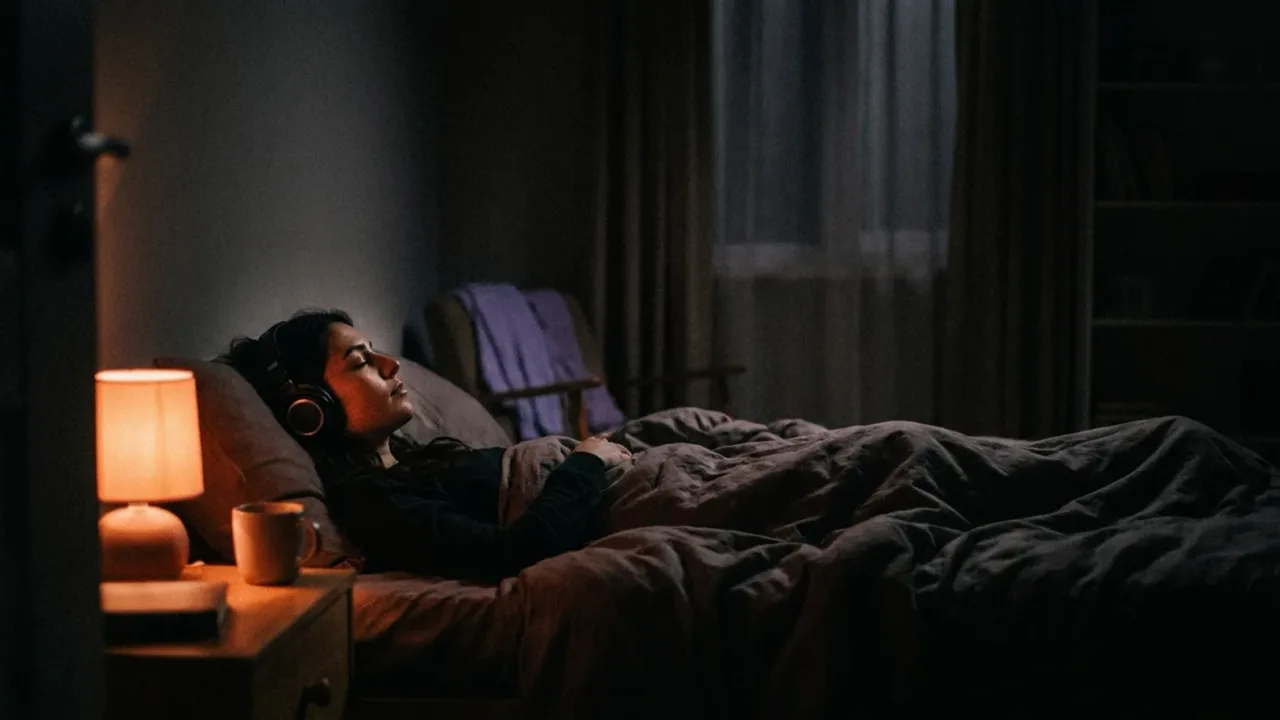

Clients often ask what they can use between appointments when bedtime is difficult. A consumer app may be one option, but it should be evaluated for the job it actually performs rather than treated as an extension of the therapeutic relationship.
This guide is for clinicians considering sleep apps for therapy clients. It covers category fit, evidence, privacy, crisis boundaries, and ways to introduce an optional tool without implying that the app is therapy. We use Tonight as a worked example because it is our product, but the evaluation questions apply more broadly.
Tonight is a consumer wellness product that creates short AI-generated, audio-led evening rituals from user input. It is not a medical device, therapist, crisis service, diagnostic instrument, or treatment for insomnia or a mental-health condition. It can be considered as an optional wind-down or cognitive-off-loading tool when that fits a client's needs and care plan. Our page for mental health professionals provides the current clinician-facing product overview.
What app do therapists recommend for sleep?
There is no single sleep app that therapists universally recommend. The right choice depends on the problem, the evidence for the intervention, the client's preferences, the role of the device itself, and whether a consumer tool is appropriate at all.
It is more useful to separate categories:
- CBT-I programmes and tools. Cognitive Behavioral Therapy for Insomnia is a first-line treatment for chronic insomnia. Digital CBT-I programmes may deliver components of an evidence-based treatment, but quality, clinical oversight, availability, and evidence vary by product.
- Sleep tracking. Tracking can be useful for some clinical questions and for some clients. For others, frequent checking or score-focused behaviour may increase sleep-related worry. Do not assume either benefit or harm without considering the individual use case.
- Meditation and relaxation. These can be useful wellness or coping practices for people who like them. They should not be described as treatments for insomnia unless the specific intervention and evidence justify that claim.
- Sound and soundscapes. These may provide a low-demand listening option. They do not diagnose the reason someone is awake.
- Cognitive off-loading and wind-down tools. These can help a person write down tasks or thoughts and move away from active planning. Tonight belongs in this consumer-wellness category.
A wellness app is not the appropriate response to a psychiatric emergency, active suicidal or self-harm risk, psychosis requiring urgent assessment, suspected untreated sleep-disordered breathing, or another presentation requiring clinical evaluation. In those situations, assessment, treatment, crisis support, or emergency care takes priority.
What changes between sessions at night?
Some clients report that rumination, worry, or frustration with wakefulness becomes more noticeable once daytime activity stops. Insomnia research includes hyperarousal and conditioning models, but those models should not be reduced to a story in which the Default Mode Network "takes over," the nervous system "keeps watch," or prefrontal control disappears at 3 a.m.
For chronic insomnia, the learned relationship between bed and wakefulness can be clinically relevant, which is one reason stimulus control is a component of CBT-I. The details belong inside an evidence-based insomnia protocol, not inside a generic wellness-app script. Our field note on the science of hyper-vigilance discusses the broader concept with the same caution.
A useful between-session tool should make one agreed action easier to perform. It should not try to become the clinician who is absent.
If a client says, "I know what we discussed, but I do not remember it when I am tired," a simple external prompt may be helpful. That is a usability problem. It does not require claims about low executive function, autonomic arousal, or an app "holding the gap" in clinical care.
Why format and adherence matter
Paper handouts, notebooks, audio, and apps each have strengths and weaknesses. A digital interface is not automatically more effective than an analogue tool.
- Accessibility. Some clients prefer an audio prompt because they do not want to remember a sequence. Others prefer paper because a phone itself is distracting.
- Light and device use. A dark interface can reduce screen brightness, but a phone still emits light and may invite other activity. A bedside lamp does not automatically "suppress melatonin" enough to make a paper journal clinically inferior; intensity, spectrum, timing, duration, and the individual context matter.
- Adherence. People are more likely to use an approach that is simple, acceptable, and already prepared. Do not assume physiological arousal makes clients unable to remember a handout or that an app removes the need for effort.
The best format is the one that supports the agreed goal with the least unnecessary friction.
What an adjunct wellness tool should (and shouldn't) do
When a clinician recommends a third-party consumer app, boundaries should be explicit.
- It should not diagnose or treat unless it is actually designed, regulated, and evidenced to do so. Tonight does not diagnose or treat Insomnia Disorder, GAD, PTSD, depression, or another condition.
- It should not simulate a therapeutic relationship. Tonight's AI does not understand the client, form an alliance, provide clinical interpretation, or offer reciprocal human presence.
- It should not replace care. A client should not be told that the app will "hold the line," provide clinical support between appointments, or take over when the therapist is unavailable.
- It can provide a bounded function. For Tonight, that function is a short user-initiated input followed by an AI-generated audio ritual intended as a wellness and wind-down experience.
The current product boundaries are also described on our professionals page.
A consumer wellness tool is not a therapeutic intervention or clinical bridge. Evaluate the current product, privacy information, accessibility, crisis boundaries, and fit for the individual client before recommending it. If you need product-specific information, contact us directly.
Cognitive off-loading and unfinished thoughts
Cognitive off-loading is the broad idea of using the environment to reduce what must be actively remembered or mentally managed. Writing down tomorrow's tasks is a simple example.
The Zeigarnik effect is often summarized as better memory for interrupted or unfinished tasks, but it should not be turned into the claim that every racing thought is an "open loop" that must close before sleep. Nor should a brain dump be promised to lower pre-sleep cognitive activity in a particular person.
A more defensible use is practical: if a client is repeatedly rehearsing tomorrow's tasks because they do not want to forget them, writing the tasks somewhere can reduce the need to keep rehearsing them. Tonight can accept a short user input and generate a temporary audio experience from it; it does not hold the thought in a human or therapeutic sense.
Breathing and grounding as optional practices
Breathing exercises, body scans, and sensory-orientation exercises are commonly used as relaxation or grounding practices. They can be useful for some clients and uncomfortable or unhelpful for others.
Tonight's audio may include simple non-clinical prompts. Those prompts should not be described as moving a client into a "window of tolerance," triggering parasympathetic activation, regulating a dysregulated nervous system, or communicating "you are safe." Those are stronger clinical and physiological claims than a consumer wellness tool can support.
- Breathing is optional. Slow breathing can be offered without promising a vagal or parasympathetic reset.
- Attention prompts are optional. A body scan or sensory countdown can be skipped if internal focus increases distress.
- No interpretation. The AI should not infer what a sensation means or turn a wellness exercise into trauma processing.
If a clinician wants a client to practise a specific therapeutic skill, the clinician remains responsible for defining that skill, its rationale, and when it should or should not be used.
Professional integration without extending the therapist
A consumer app should not be presented as extending the clinician's influence beyond the 50-minute hour. That framing blurs the distinction between clinical care and a product.
A safer model is simple: the clinician may recommend or permit an optional tool for a clearly defined wellness task, and later ask the client how it went. The app does not make homework "actually happen," monitor adherence for the clinician, or continue the therapeutic relationship.
For practices that want to evaluate Tonight, we provide clinician-facing resources and information about professional access. These materials should help you assess fit, not pre-approve the product for every caseload.
For Clinicians
Evaluate Tonight as an optional wellness tool
Review the Clinician Resource Pack, current product boundaries, privacy information, and introduction materials before deciding whether it fits a particular use case.
Integrating it into a care plan
If a clinician chooses to include a consumer wellness app alongside treatment, the clinical protocol comes first.
For CBT-I, stimulus control should be delivered according to the clinician's evidence-based protocol and the client's circumstances. Do not turn the common shorthand "if you are awake for twenty minutes, leave the bed" into a universal app instruction. Clock-watching can itself increase sleep pressure, and modern CBT-I guidance often focuses on getting out of bed when unable to sleep rather than requiring a precise stopwatch threshold.
If Tonight is used during a clinician-directed routine, it should occupy only the role the clinician has chosen — for example, a low-demand audio option outside the bed or a place to enter one thought before returning to the agreed protocol. It does not determine when the client should leave or return to bed.
At a later session, the clinician can ask about the client's experience: "Did the tool make the routine easier, harder, or no different?" That reflection may be useful discussion material. It is not a clinical measurement generated by the app. For questions about fit, visit the professionals page or contact us.
Privacy and crisis boundaries
Any tool used around mental-health care deserves careful privacy review. Clinicians should verify the current policy rather than relying on marketing shorthand.
- Data minimisation. Tonight is designed around ephemeral user input rather than a persistent clinical record. It is not an EMR.
- AI training. Tonight's product position is that user thoughts are not used to train AI models. Clinicians should review the current privacy documentation for the exact implementation and retention terms.
- Processing has a narrow purpose. User input is processed to generate the requested experience; it should not be described as being processed to achieve "immediate down-regulation."
- Crisis use is out of scope. Tonight is not a suicide-risk assessment tool, crisis line, emergency service, or acute-care intervention. A user at imminent or significant risk needs real human, clinical, crisis, or emergency support appropriate to the situation.
If product safeguards surface crisis resources in response to high-risk language, those resources are a redirect away from the wellness experience, not an "emergency session" and not evidence that the app can manage acute risk. For due-diligence questions, contact us.
Scripting the introduction: three ways to bring it up
Keep the introduction neutral and keep clinical ownership with the provider.
1. For repetitive task thoughts
"You mentioned that you keep rehearsing tomorrow's tasks at night because you are afraid you will forget them. If you want, you could try writing them down before bed. Tonight is one digital option that can turn a short input into a guided audio ritual. Notice whether using it reduces or increases bedtime effort, and we can discuss that next time."
2. Alongside clinician-directed CBT-I
"Keep following the stimulus-control plan we agreed on; the app does not change that plan. If you want something low-demand to listen to during the part of the routine we discussed, Tonight is one option. Stop using it if the phone, audio, or choices make you more alert."
3. For a familiar relaxation practice
"If the breathing exercise we practised is comfortable for you, you can use the same exercise on your own or with a simple audio guide. Tonight may generate similar non-clinical prompts, but you do not need the app, and you should skip any prompt that does not fit the plan we made."
Next Step
Evaluate Tonight for your setting
If you are considering consumer sleep apps for therapy clients, review the product yourself before recommending it and match the tool to a defined, non-clinical function.
Frequently asked questions
Is Tonight a medical device or a replacement for CBT-I?
No. Tonight is a consumer wellness product. It does not diagnose or treat insomnia or a mental-health condition, and it is not a replacement for CBT-I, therapy, medical assessment, crisis care, or another indicated treatment. A clinician may choose to use it only as an optional wellness tool alongside a separately defined care plan.
How does the AI "Whisperer" function?
The AI produces bounded audio or text guidance for the consumer experience. It may include simple relaxation, breathing, or sensory prompts, but it does not understand the client, form a therapeutic alliance, interpret symptoms, regulate a nervous system, or guarantee parasympathetic activation.
How is a crisis handled if a client enters high-risk text?
Tonight is not a crisis or suicide-risk service and should not be relied on to manage psychiatric emergencies. If high-risk language triggers a product safeguard, the appropriate function is to direct the user toward real human, crisis, emergency, or clinical support. A wellness breathing or grounding exercise must never be presented as an emergency intervention or as enough to "get through the night" in place of acute care.
Does the app collect sensitive client or therapeutic data?
Tonight is not an EMR and is designed around ephemeral user input rather than a persistent clinical record. Its stated product position is that user thoughts are not sold or used to train AI models. Providers should still review the current privacy policy and data-handling documentation before recommending the product to a specific population.
Is the interface safe for circadian rhythms?
No phone interface can be described as universally "safe for circadian rhythms." Tonight uses a dark, low-light design intended to reduce visual stimulation, but the device still emits light and can still become a source of interaction. Clients who are sensitive to device use at night may prefer an analogue or screen-free alternative.
Can providers test it first, and are there professional pricing models?
Providers can review the current professional resources and evaluation options on our professionals page or ask product-specific questions through our contact page. Availability and pricing should be checked there because they may change.