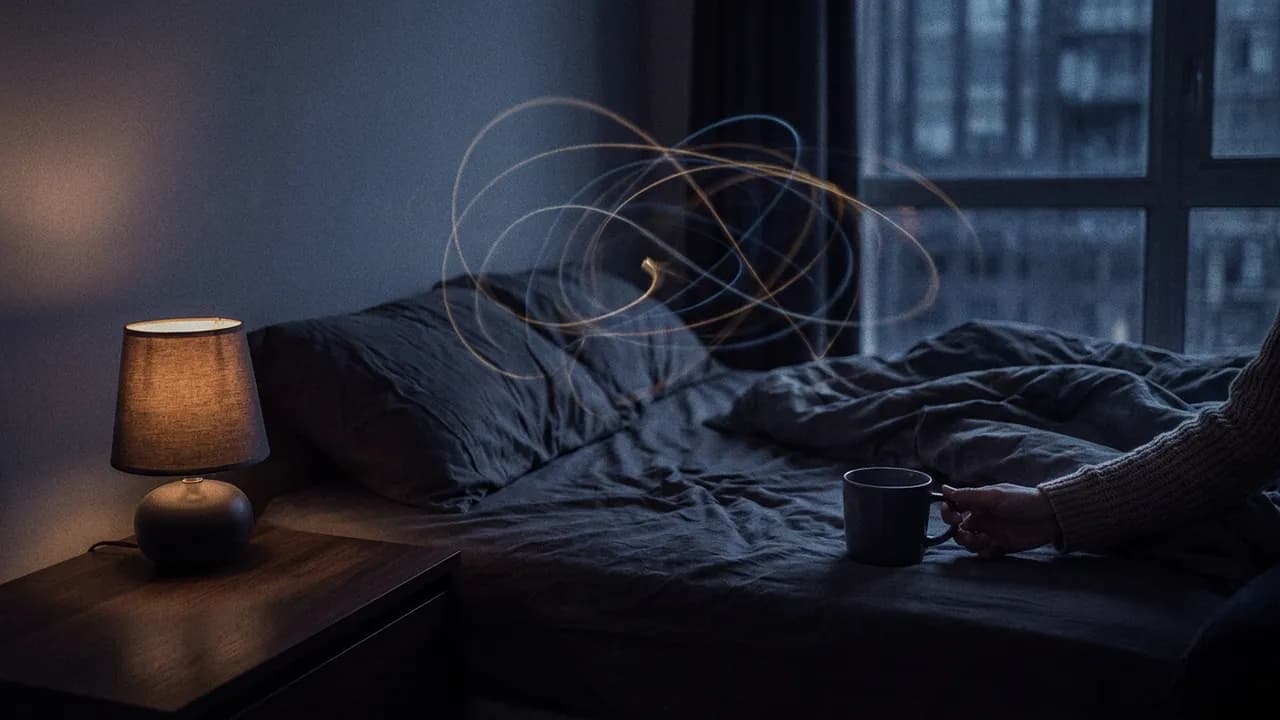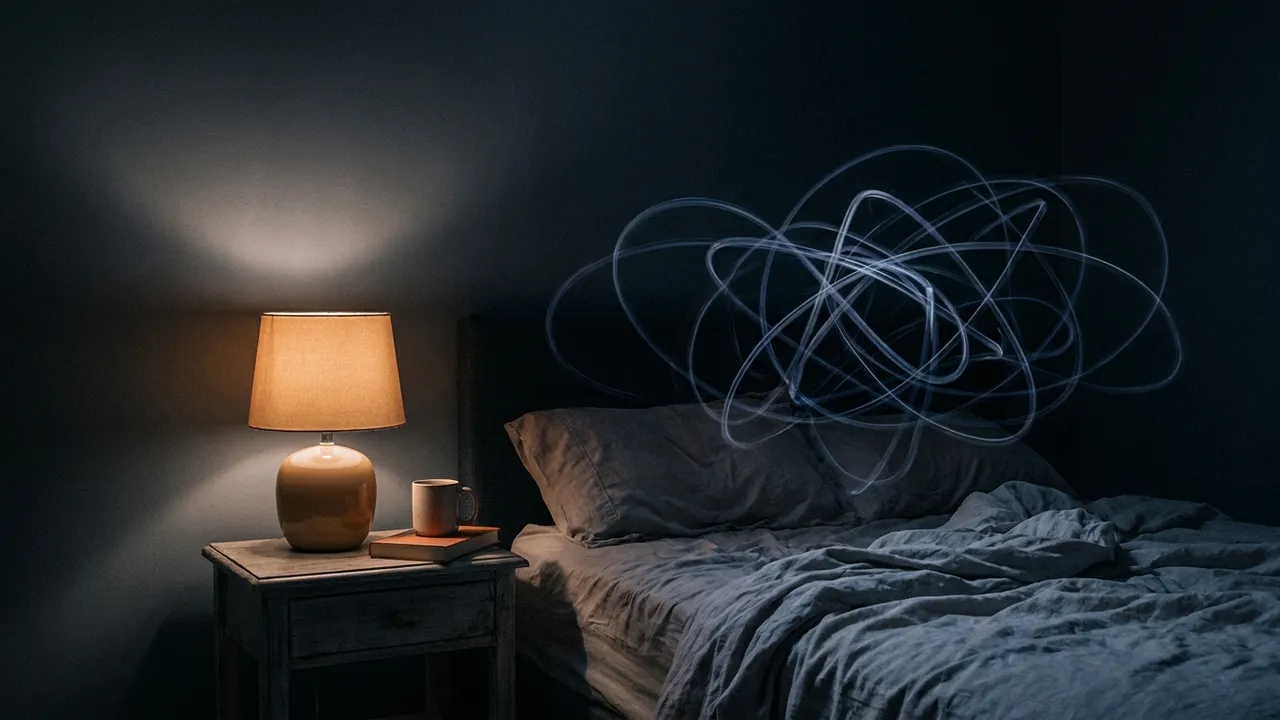
The room is doing everything right. The light is off. The sheet is cool against your ankle. Somewhere, a pipe clicks in the wall, then goes quiet. Your phone is face down. The day is over.
But inside your head, the meeting begins.
A sentence you said three years ago walks in first. Then the email you forgot to answer. Then the bill, the appointment, the thing your friend meant by that tone, the sharp little question of whether you are becoming the wrong version of yourself. You try to lie still. You try to be reasonable. You try to turn off brain to sleep, as if there is a switch behind the ear.
There is not.
If you can't sleep because of overthinking, the goal is usually not to force thoughts away, but to give your attention somewhere else to go.
This article introduces Cognitive Shuffling, a technique proposed by cognitive scientist Luc Beaudoin that uses a stream of unrelated images or words. Some people find it useful, but the evidence is still limited and it is not an established treatment for insomnia.
If you can't sleep because of overthinking, the problem is not that you are weak, dramatic, or bad at rest. Your thoughts may simply have found a groove and keep returning to it.
This is where a softer kind of effort can help. Not another command. Not "calm down." Not a lecture delivered by your own exhausted brain at 12:47 a.m. A small cognitive detour. A way to give your attention somewhere harmless to go.
It Feels Like Your Brain Has a Mind of Its Own
Not Just Thoughts, but Weather
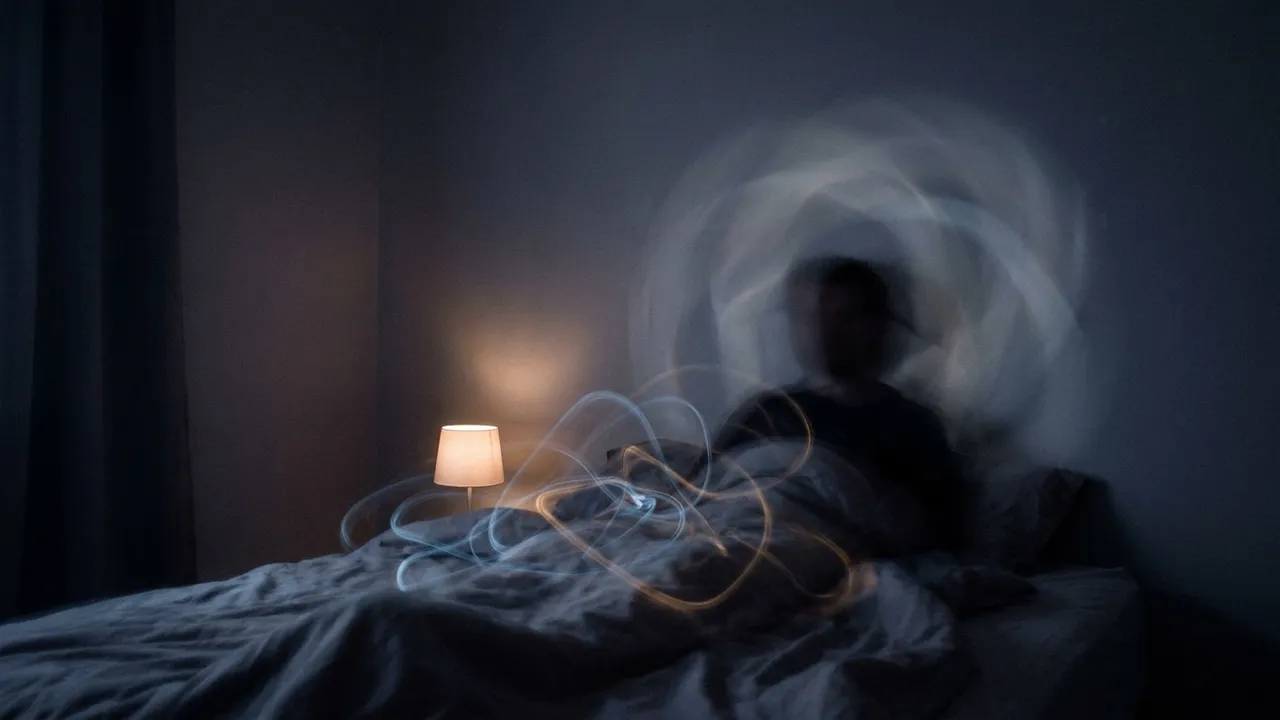
Overthinking at night can feel almost physical. Not just thoughts, but weather. A pressure behind the forehead. A tightness under the ribs. Your jaw set without permission. The pillow warming beneath your cheek while your body waits for the mind to dim.
You may notice your thoughts arriving in loops rather than lines. They do not solve anything. They circle. They rehearse. They make arguments, open tabs, drag old evidence into the room. One part of you knows you need sleep. Another part keeps sorting, remembering, predicting.
When the Ceiling Becomes a Screen
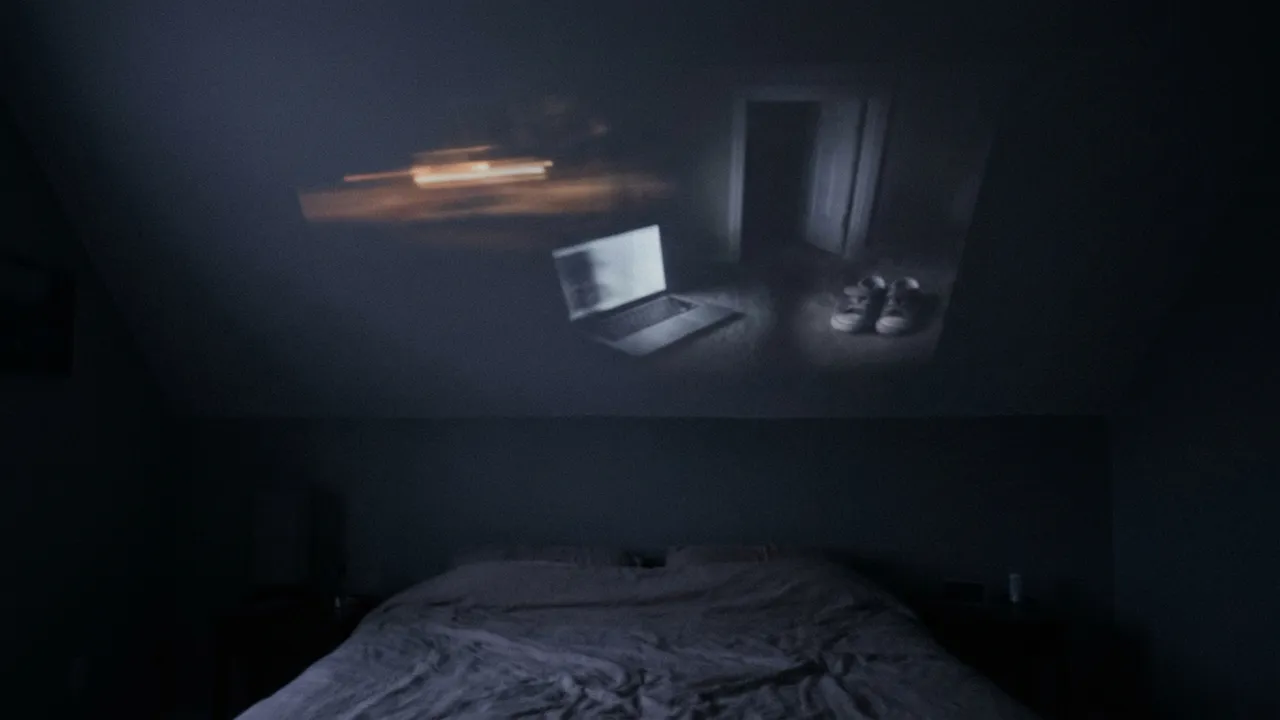
Bedtime asks you to stop doing. During the day, you can answer a message, wash a cup, cross a street, stand in front of the fridge, put your hand on a door handle. At night, there is almost nothing to do except be with yourself. The ceiling becomes a screen. The streetlight makes a pale square above the curtains. Your thoughts become loud enough to have texture.
And then the second layer arrives: frustration. Why am I doing this again? Why do I overthink when I try to sleep? Why can everyone else just close their eyes and disappear?
Many people ask those questions in the dark. Many people lie beside someone they love and still feel alone with the machinery of their own mind. A busy mind at bedtime is not proof that something is wrong with you.
You Do Not Have to Defeat the Mind
A looping thought may be trying to solve a problem, prevent a mistake, or make sense of something unfinished. But repeating it at midnight often does not bring you closer to an answer.
The goal is not to defeat the mind. The goal is to stop giving the loop a road.
That distinction matters. Because the harder you try to suppress a thought, the more attention you may end up giving it.
Why Your Brain Gets Louder at Night
When There Is Less Competing for Your Attention
The brain supports self-reflection, memory, and imagining the future through several interacting systems. Researchers often discuss the Default Mode Network in this context, but you do not need a brain-network explanation to understand the everyday experience: when outside demands quiet down, internal thoughts can become more noticeable.
During the day, a kettle whistles. A coworker asks a question. A child needs socks. A car horn cuts across the street. Your attention keeps being pulled outward, toward objects, faces, deadlines, weather. Even if your worries are there, they have to share the room.
When the Room Empties, the Thoughts Get More Space
At night, the room empties.
There are fewer demands from the world, so memories, plans, worries, and self-reflection can take up more space. The silence does not create the thoughts. It simply makes them easier to notice.
If you have ever wondered how to stop overthinking at night, it helps to understand this first: you may not be becoming more irrational. You may simply have fewer competing tasks.
Sometimes that quiet is useful. An insight surfaces. You remember something important. You feel something you were too busy to feel at noon. But the same quiet can also turn into a courtroom where you are judge, witness, and defendant.
The White Bear Problem
Thought suppression can make this worse. This is the effort to force a thought away. Do not think about work. Do not think about the diagnosis. Do not think about the argument. The trouble is that part of the mind has to keep checking whether the forbidden thought is gone, which can keep bringing it back.
Psychologist Daniel Wegner's Ironic Process Theory is often illustrated with the famous white-bear example: try very hard not to think of a white bear, and the bear may become unusually difficult to ignore.
Sleep rarely responds well to mental force. A gentler option is to give attention something simple and low-stakes to follow. If this sounds familiar, you may like reading more about why you can't shut your brain off at night.
The Overthinking & Stress Cycle
Thoughts Can Come With Physical Tension
Overthinking does not always stay abstract. You remember the unpaid invoice and your stomach tightens. You imagine tomorrow's conversation and your heart begins to thud. You replay a mistake and your face warms in the dark.
Worry can come with physical signs of arousal such as muscle tension, a faster heartbeat, or shallower breathing. Those sensations can then become new material for worry.
When You Start to Worry About Not Sleeping
Then comes the most frustrating part. You begin to worry about not sleeping.
You check the clock. You calculate. If I fall asleep now, I can get six hours. Then five and a half. Then five. The math becomes its own little punishment. You imagine tomorrow's fatigue before tomorrow has even arrived. Now the problem is not only the original worry. The problem is sleep itself.
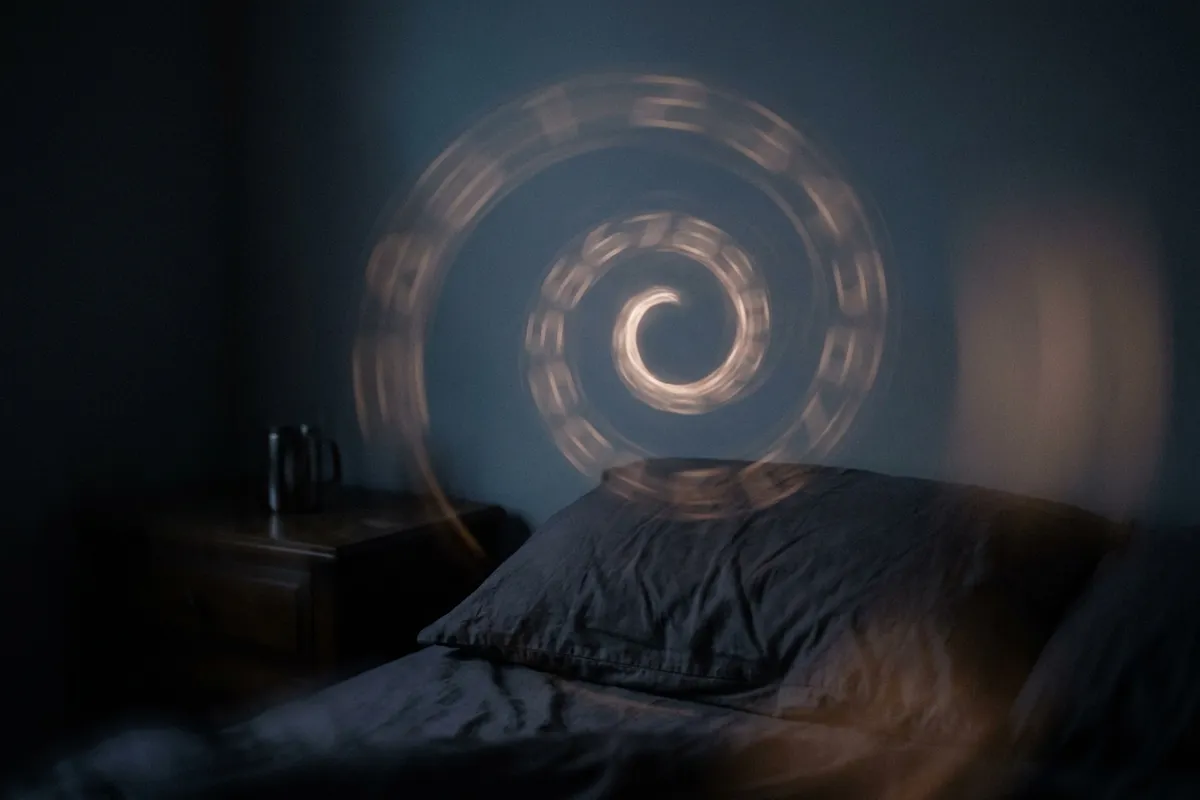
This is how the loop can tighten. Overthinking increases alertness. Alertness makes sleep harder. Difficulty sleeping becomes new material for overthinking.
If your brain feels too active to sleep, it may not need a better argument. It may need a change of channel.
Why "Just Relax" Falls Flat at Midnight
Advice like "just relax" can feel useless because relaxation is not an on/off command. Sometimes it helps to reduce stimulation, stop clock-checking, write down what needs remembering, or give attention to something neutral.
If your pulse becomes especially noticeable in bed, you might find comfort in our piece on a heartbeat loud when trying to sleep, which separates ordinary awareness of a heartbeat from symptoms that deserve medical attention.
The loop can be loosened without proving every worry wrong at midnight. One option is to gently interrupt the story-building.
A Gentle Technique to Occupy Your Mind: Cognitive Shuffling
Where Cognitive Shuffling Comes From
Cognitive Shuffling is a technique proposed by cognitive scientist Luc Beaudoin for the mind that will not stop making stories.
Instead of trying to stop thought, you give the mind a series of random, neutral images. A bottle. A meadow. A ladder. A blue mug. A candle. A dog asleep in a patch of sun.
Nothing needs to connect.
That is the point.
When you are overthinking, the mind tends to build coherent narratives. It links one thought to the next: I forgot to reply, which means they are annoyed, which means I am unreliable, which means tomorrow will be terrible. Cognitive Shuffling deliberately replaces that sequence with unrelated material.
The method has some preliminary research behind it, but it has not been established as a standard treatment for insomnia. A broader systematic review of pre-sleep cognitive strategies found that different techniques can help, do little, or sometimes make things worse depending on the method and study. So treat Cognitive Shuffling as an experiment, not a promise.
Why Random Images Might Help
One proposed explanation is that unrelated images occupy attention without creating another meaningful story. Working memory is limited, so keeping a few neutral items active may leave less room for a worry narrative in that moment. That mechanism is plausible, but it should not be presented as settled proof of why the technique works.
You are not turning the mind off. You are giving it something else to do.
For someone wondering how to fall asleep when your mind is racing, that may feel easier than trying to empty the mind completely. If it makes you more frustrated or alert, stop and use something else.
Choosing Concrete, Ordinary Images
The images should be concrete. Not concepts like success, failure, money, forgiveness. Choose things you can almost see or touch. A spoon. A pear. A wool sock. The porch light. A red bicycle leaning against a fence. The more ordinary, the better.
If a worry barges in, that does not mean you failed. Notice it as lightly as you can, then return to the next image. The practice is not purity. It is return.
How to Practice Cognitive Shuffling Tonight
Start With One Word in the Dark
You can practice Cognitive Shuffling without an app, a candle, a notebook, or a perfect bedtime routine. You can do it with one word, in the dark, with your cheek on the pillow and one foot searching for the cool place in the sheets.

Choose a neutral word. Something emotionally plain. "Bedtime" works because it is already near sleep, but not loaded. You will use its letters as prompts for images.
The Shape of It, Step by Step
Here is the shape of it:
- Start with the first letter: B.
- Silently name a word that begins with B, then picture it for a few seconds. Boat. A small boat tied to a wooden dock.
- Choose another B word. Blanket. A folded gray blanket at the end of a bed.
- Keep going until the letter feels used up, or until you get bored.
- Move to the next letter: E. Envelope. Egg. Elm tree. Empty bowl.
- Continue through the word, letting the images stay random and unimportant.
You do not need to be clever. If you spend too long searching for the perfect image, choose a simpler one. Ball. Book. Bird. If an image becomes emotionally charged, let it pass and pick another.
The practice should feel like laying small stones across a stream. One image, then another. No bridge to build. No destination to reach.
Some people prefer to imagine the objects vividly: the orange peel curling on the counter, the white bowl in the sink, the moth at the lampshade. Others only name them faintly and move on. Both are fine.
When the Mind Wanders Back, and the 3 a.m. Hour
The important thing is randomness. The anxious mind wants sequence. It wants because, therefore, what if, and then. Cognitive Shuffling gives it lamp, river, button, feather.
If you lose track, fine. If you suddenly realize you have been thinking about tomorrow for three minutes, also fine. Begin again with the next letter. No scolding. No inner clipboard.
This can also be tried after a middle-of-the-night waking if your thoughts immediately start running. If that hour has its own particular charge for you, we have written about why you wake up at 3 AM every night.
But tonight, keep it simple. Pick the word. Follow the letters. Let each image appear and dissolve. If the exercise turns into another performance test, drop it.
Sleep is not something you can force by getting a technique exactly right.
When Shuffling Isn't Enough: The Cognitive Dump
Some nights the mind is not looking for distraction. It is holding things it refuses to put down until they are written somewhere. A simple cognitive dump means taking the contents of your mind and placing them on paper. No perfect journal required.
- Write the date and the sentence: "What my mind is carrying tonight."
- Write everything down, fast and without organizing it.
- Do not edit for kindness, logic, grammar, or importance.
- When a to-do appears, write the very next physical action beside it.
- When the page slows, close the notebook.
Give Vague Worries Edges
That fourth step can make a vague responsibility more concrete. Instead of "fix taxes," write "find W-2 in desk drawer." Instead of "deal with dentist," write "call dentist at 9."
A small 2018 laboratory study in 57 healthy adults aged 18–30 compared five minutes of writing a specific to-do list with writing about completed tasks before an overnight sleep recording. The to-do-list group fell asleep faster on average, and more specific lists were associated with shorter sleep-onset latency. That is interesting evidence, but it was one small lab study in young adults, not a guarantee that a bedtime list will help everyone. Read the study.
If the thought is not a task but a fear, write it as plainly as you can. "I am afraid I disappointed her." "I feel behind." You do not have to solve it on the page.
Then close the notebook. The point is practical: you have recorded what you want to remember and can return to it tomorrow.
The Auditory Anchor: Give Your Brain a Simpler Job
An auditory anchor is a single source of sound you rest your attention on when your mind is loud. A calm voice. Soft rain in leaves. The faint hush of waves, a low drone, music without sharp edges. The sound is not there to entertain you or drown out your thoughts. It simply gives attention one gentle place to return to.
Attention is limited, so focusing lightly on one steady sound may make it easier to disengage from a worry loop. It will not work for everyone. Some people sleep better in silence.
A warm recorded or synthetic voice can also be easier to follow than silent instructions for some people. Tone and pacing matter, but a recording is not human company, co-regulation, or a substitute for talking with someone you trust.
Letting a Voice Be Your Guide
The Trouble With Doing It Alone
There is one difficulty with any self-directed technique: you have to remember to do it at the exact moment you are tired and frustrated.
When you are rested, Cognitive Shuffling sounds simple. At midnight, even choosing the word can feel like another little chore.
This is where spoken guidance can help.
Why a Voice in the Dark Can Help
Not a lecture. Not a productivity tool wearing pajamas. A calm, carefully crafted voice can provide the next prompt so you do not have to decide what comes next.
A guided ritual can also lower the pressure to evaluate every minute. Is this working? Am I sleepy yet? Why am I still awake? The audio keeps moving, so you can simply follow it or stop if it is not helping.
Tonight is an AI-guided evening ritual with carefully crafted voices, shaped by humans for warmth, screen-free and low-light. It is a consumer wellness tool, not therapy or treatment for insomnia. A ritual may give you a simple sequence to follow when your mind feels busy, but it cannot listen to you or replace human support.
If you can't sleep because of overthinking, you do not need to become empty. You do not need to solve your life before morning. You can give the thoughts somewhere to land that is not another spiral.
If sleep difficulty is persistent, severe, or affecting daytime life, consider speaking with a qualified healthcare professional. Cognitive behavioural therapy for insomnia (CBT-I) is an established first-line treatment for chronic insomnia.
If you would like a simple guided ritual waiting for you at night, you can download Tonight.
Related reading: brain too active to sleep · anxiety overthinking at night
Frequently asked questions
Why can't I sleep because of overthinking?
At bedtime there are fewer outside demands competing for your attention, so worries, memories, and unfinished tasks can become more noticeable. Worry can also come with physical tension or alertness, and worrying about not sleeping can create another loop. That is common and does not by itself mean something is wrong with you.
How do I stop overthinking at night?
Rather than trying to force thoughts away, you can give your attention a different task: write down what needs remembering, stop clock-checking, focus on a neutral sound, or try a simple imagery exercise. If one technique makes you more frustrated, drop it. Persistent insomnia deserves evidence-based care rather than endless self-help experiments.
What is Cognitive Shuffling and does it help with overthinking?
Cognitive Shuffling is a technique proposed by cognitive scientist Luc Beaudoin in which you picture a series of unrelated, neutral objects or images. Some preliminary research exists, but it is not an established insomnia treatment and the exact mechanism is not settled. Treat it as an optional experiment, not a sleep guarantee.
Why does my anxiety and overthinking feel worse at night?
During the day, tasks, people, movement, and noise compete with your worries. At night those interruptions fall away, so the inner world can feel louder. Tiredness and frustration about sleep can also make thoughts feel harder to manage, without requiring a special nighttime brain or hormone explanation.