
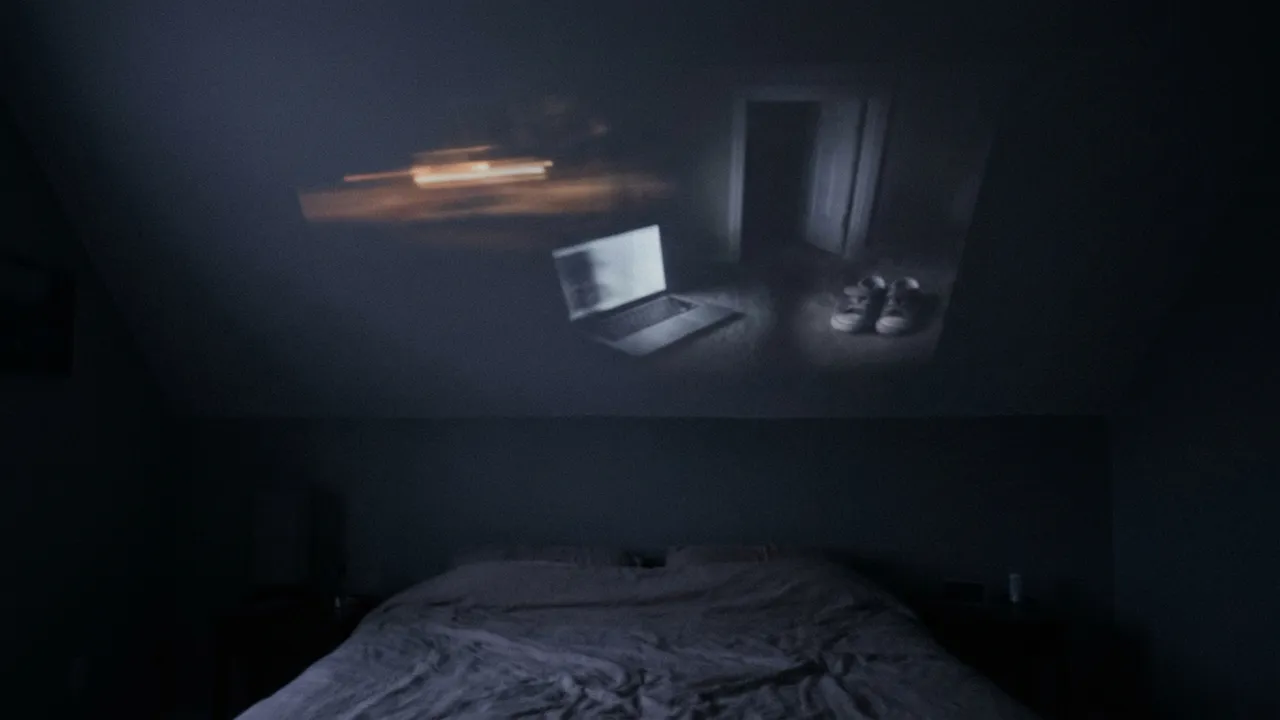
The room is dark. The house has gone soft around the edges. Maybe the heat clicks in the wall. Maybe a car passes outside and leaves a stripe of light across the ceiling. Your body is lying down, but your mind has already left.
It is standing in tomorrow.
It is opening the laptop. It is reading the email. It is walking into the meeting five minutes late. It is hearing the tone in someone's voice before that person has spoken. It is remembering the grocery list, the appointment, the thing you forgot to send, the child's shoes by the door, the awkward conversation you might have to finish. The whole next day begins to play in your head like a movie with no pause button and terrible lighting.
To stop worrying about tomorrow before bed, try giving tomorrow a separate place earlier in the evening.
One option is a brief constructive-worry exercise: write down the concerns that keep returning and, where possible, one practical next step for each. The aim is not to guarantee sleep or send a biological "all done" signal. It is simply to stop using the bed as the main place for planning.
Worrying ahead does not mean you are broken. It means something about tomorrow feels unfinished or uncertain.
The 'Tomorrow Movie' Playing in Your Head
This is one of the loneliest forms of being awake. You are in bed, where very little can be solved, while your mind keeps moving through a day that has not happened yet.
The Ache of 'I Can't Sleep Thinking About the Next Day'
If you have ever thought, I can't sleep thinking about the next day, you know the particular ache of it. The pillow becomes a desk. The blanket becomes a calendar. Your chest may feel tight. Your jaw may clench without asking you. Even ordinary tasks can feel much larger at midnight.
When Work Disguises Itself as Responsibility
Pre-sleep anxiety about work can be especially sharp because worry can sound like responsibility. Just think this through one more time. Rehearse it now so you will be ready later. Rest starts to feel like something you must earn by solving tomorrow in advance.
Tomorrow Can't Be Solved From Bed
But tomorrow cannot be fully solved from bed.
You can prepare. You can care. You can make a list. But if anxiety about tomorrow is keeping you awake, the task is not to become a person who never worries. The task may be to give worry a proper time and place so it does not have to occupy the whole night.
This is Anticipatory Anxiety: Worry About What Hasn't Happened Yet
Anticipatory anxiety means anxiety about a future event or outcome: a meeting, a hard conversation, a medical result, a long day, an uncertain decision. The mind starts simulating what could happen in an attempt to prepare.

The Quiet Gives Tomorrow More Space
At night there are fewer distractions. No dishes clattering. No inbox refreshing. No errands pulling your attention outward. In that quiet, imagined conversations and future tasks can take up more of the room.
You do not need an amygdala, cortisol, or vagus explanation for this ordinary pattern. Worry itself can make you feel more alert, tense, or physically uncomfortable, and those sensations can make sleep feel harder.
How Anxiety Invites Catastrophizing
Anticipatory anxiety often invites catastrophizing. A late email becomes a reprimand. A presentation becomes humiliation. A busy morning becomes proof that you will fail at everything. The mind can jump from uncertainty to the worst possible ending without evidence that the worst ending is likely.
If this sounds familiar, you may also recognize the broader pattern described in Why You Can't Shut Your Brain Off at Night.
You Can Practice a Different Routine
The useful part is not teaching your nervous system a safety signal. It is building a repeatable routine: look at tomorrow while you are still awake enough to make decisions, record what matters, then stop doing tomorrow's work in bed.
Why 'Just Stop Worrying' Makes It Worse
Someone may have told you to just stop worrying. Maybe you have told yourself the same thing, more harshly, with your face turned toward the wall.
Stop thinking about it.
Calm down.
Go to sleep.
The White Bear Problem
The trouble is that the mind does not usually obey a command to erase. Trying not to think about a worry can make it more noticeable. Psychologists often explain this with Ironic Process Theory, or the white bear problem: if you keep checking whether a thought is gone, you keep bringing it back into attention.
Build a Threshold, Not a Wall
So if you are asking how to shut off your brain from worrying at night, the answer does not have to be an internal battle.
A threshold says: this concern is allowed to exist, but I will deal with it at another time. There may be a bill to pay, a message to send, a boundary to set, a bag to pack, a question to ask. Those tasks are real. The bed is simply a poor place to complete them.
Give Worry an Appointment
This is where a scheduled worry period can be useful. You do not deny the concern. You give it a short appointment earlier in the evening, when you can still decide whether action is possible.
The Technique: Schedule a 'Constructive Worry' Time
Constructive Worry is a structured problem-solving exercise that has been studied as a possible addition to insomnia treatment. The evidence is modest rather than definitive: one controlled study included 33 college students reporting insomnia, and a later feasibility trial included 22 patients with insomnia. Those results make the technique reasonable to try, but not something to present as a proven sleep switch.
Pick a Time While Action Is Still Possible
Choose a short period in the early evening, not while lying in bed. Fifteen minutes is a practical starting point, not a medical rule. Sit somewhere you can write and make decisions.
Write down the worries that are asking for attention. Work worries. Family worries. Money worries. The vague dread with no name. The small task that keeps tapping your shoulder. The sentence can be as simple as: I am worried I will forget to bring the form. I am worried the meeting will go badly. I am worried I will wake up already behind.
Write One Next Step for Each Worry
Then beside each worry, write one next step where one exists. Not a full life plan. One step.
If there is an action, name it. Put the form by the door. Email Maya at 9. Review the notes for ten minutes after breakfast. If there is no action available, name that too: No action tonight. Revisit after results arrive.
This is a way to separate concern from endless rehearsal. The worry has been recorded, and tomorrow has a first step.
Why Keeping Planning Out of Bed Can Help
One principle in CBT-I is stimulus control: strengthening the association between bed and sleep rather than wakeful activities. A scheduled worry exercise is not itself the whole of CBT-I, but doing planning elsewhere can fit that broader goal.
If a worry returns while you are brushing your teeth or lying down, you can remind yourself: I wrote this down. I have a next step. I can return to it tomorrow.
How to Create a 'Closing Ceremony' for Your Day
A closing ceremony is simply a repeatable way to mark that active planning is over.
Mark a Temporal Landmark at the Edge of Evening
Psychologists use the term Temporal Landmark for points in time that help people mentally separate one period from another. Research on the "fresh start effect" examined landmarks such as the start of a week, month, year, or semester. That work does not prove that a bedtime ritual changes sleep physiology, but the general idea of a clear boundary can still be practically useful.
Your closing ceremony does not need to be beautiful. It needs to be easy enough to repeat.
Worry, Next Step, Close
Try it this way:
- Choose a short worry time at least some distance from bedtime, in a place that is not your bed.
- Draw two columns on paper: Worry and Next Step.
- Put one practical response, or the words no action tonight, beside each concern.
- Read the list once, then close the notebook and put it away.
If you like, add a plain phrase: Tomorrow has a place. Tonight is for rest.
When a Worry Returns in Bed
When a worry returns in bed, and it probably will, you do not need to restart the whole meeting. Remind yourself that it is already on the list. If something truly new and important appears, write one or two words so you will remember it tomorrow, then put the paper down.
A pre-sleep routine works best when it is not another performance test. If nighttime alertness is a recurring theme for you, you may find related context in the science of nighttime hyper-vigilance.
The ceremony itself stays simple. Worry. Next step. Close. Rest.
A Ritual to Mark the True End of Your Day
After the notebook closes, there is still a small space to cross.

A Ritual Has Weight But No Pressure
A ritual can help because it reduces decisions and gives the end of the evening a familiar shape. It does not tell the body what time it is in a mysterious biological language, and it does not have to regulate anything perfectly.
Maybe your ritual is folding tomorrow's shirt over a chair. Maybe it is rubbing lotion into your hands slowly enough to feel each knuckle. Maybe it is listening to a short guided audio. The best nighttime ritual has weight but no pressure.
Where Tonight Belongs
This is where Tonight can fit: after the practical planning is finished, when you want one finite thing to follow instead of reopening tomorrow's list.
Tonight is an AI-guided evening ritual with carefully crafted voices, shaped by humans for warmth, designed to be screen-free and low-light. It is not therapy or a treatment for insomnia. It is simply a consumer wellness ritual that can give the end of the evening some structure.
A consistent routine may become familiar and easier to follow over time. That is enough of a claim. It does not need a vagus-nerve explanation or a promise that sleep will feel safer.
If you are drawn to this idea, you may like On Ritual and Rhythm, a deeper look at repeated evening gestures.
Return to the Same Small Sequence
Some nights, tomorrow will still be loud. Some nights, the list will be longer than you want. That does not mean the exercise failed.
Return to the same small sequence if it helps:
Write the worry. Name the next step. Close the book. Let the rest of the evening be something other than planning.
Tomorrow will come with its own information and its own chances to respond. You do not have to meet it in the dark ahead of time.
If worry is severe, persistent, or affecting daily life, consider speaking with a qualified mental-health professional. If chronic insomnia is the problem, CBT-I is an established first-line treatment.
If you want a short ritual for that final crossing, you can download Tonight.
Related reading: Pre-sleep anxiety about work · the worst possible ending · overthinking at night
Frequently asked questions
How do I stop worrying about tomorrow before bed?
One option is to give tomorrow a short planning period earlier in the evening. Write down the worries that keep returning and, where possible, one practical next step for each. Then close the notebook and leave the rest for tomorrow. The aim is not to guarantee sleep, but to stop doing most of your planning in bed.
What is constructive worry?
Constructive worry is a structured exercise in which you write down concerns and possible next steps at a set time rather than continuing to rehearse them in bed. Small studies suggest it may reduce pre-sleep cognitive arousal or add benefit to behavioral insomnia treatment, but the evidence is limited and it is not a stand-alone cure for insomnia.
Why can't I stop thinking about the next day when I try to sleep?
At night there are fewer tasks and distractions competing for your attention, so future plans and uncertainties can become much more noticeable. Worry can also make you feel tense or alert. That does not require a special nighttime alarm-system explanation; it is a common pattern of attention and anxiety.
Does scheduling a worry time really help you sleep?
It may help some people, but the research is small. A 33-person controlled study found reduced pre-sleep cognitive arousal, and a 22-person feasibility trial tested constructive worry as an addition to behavior therapy for insomnia. Treat scheduled worry as an optional tool, not a sleep guarantee.