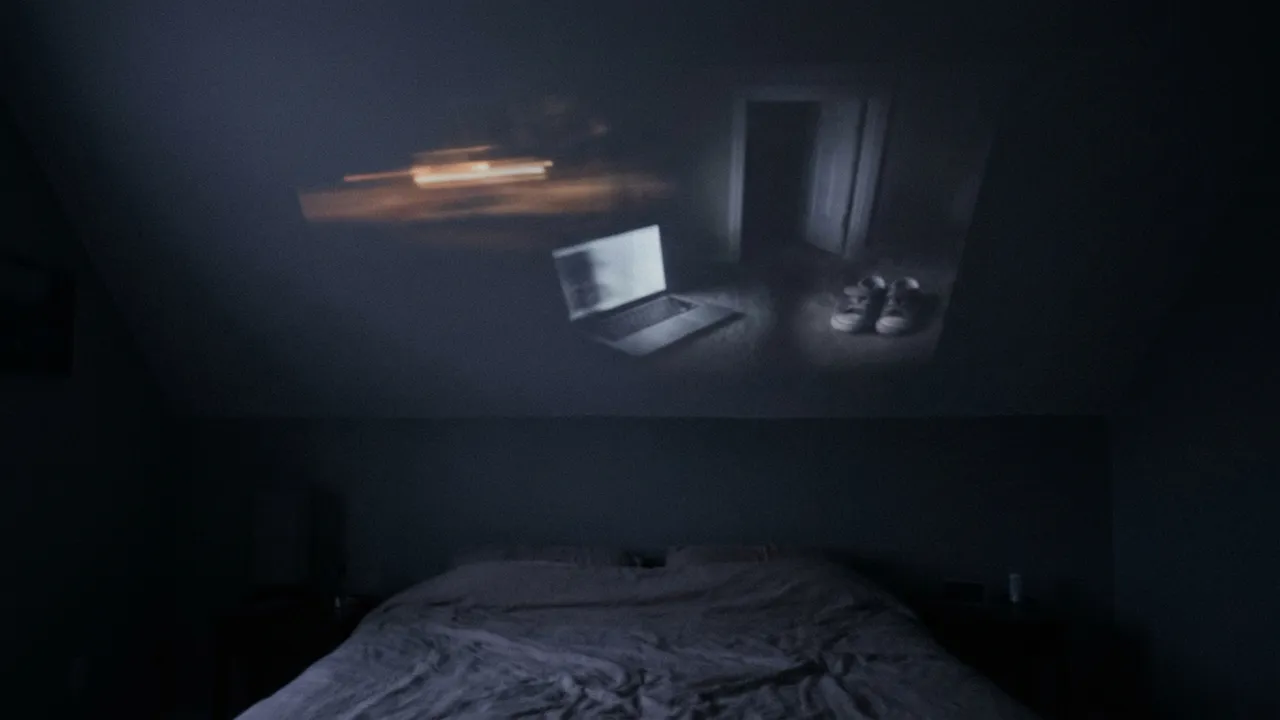

The room goes quiet, and the sentence comes back.
Not the important sentence. Not the beautiful one. The crooked one. The thing you said too quickly in the hallway, the joke that landed with a soft thud, the goodbye that sounded colder than you meant it to sound. You are under the blanket. The light is off. Your phone is face down or glowing faintly on the table. Your body is horizontal, but your mind has gone back to the table, the meeting, the doorway, the car ride, the text thread.
You hear yourself again. You watch their face again. A small heat rises in your chest. Your stomach tightens. The pillow feels suddenly too warm. You think, why did I say it like that? Then, as if your mind is an exhausted editor with a red pen, it offers revisions. You could have said this. You should have paused there. You should have laughed less. You should have asked one more question. You should have never opened your mouth at all.
When you're searching for how to stop replaying conversations in your head, you're usually looking for relief from a loop that is no longer helping you understand what happened.
One gentle option is to redirect attention to a sensory external anchor — a steady sound, the weight of the blanket, or another simple sensation in the room. The aim is not to erase the memory. It is to stop spending the whole night inside it.
You are not broken because your mind replays. Social moments matter, and uncertainty is uncomfortable. But you do not have to keep reviewing the same ten seconds until morning.
Is Your Mind a Broken Record When You Try to Sleep?
This is the nightly replay. If you are searching for how to stop replaying conversations in your head at night, you are probably not looking for a lecture. You are looking for the small mercy of not being followed into bed by your own words.
The Special Cringe That Arrives After Dark
There is a special kind of cringe that arrives after dark. It takes an ordinary moment from the day and rubs it raw until it starts to feel like evidence. Evidence that you were awkward. Evidence that someone is upset. Evidence that you are too much, or not enough, or somehow both.
The trouble is that memory gives you your own angle again and again. You can replay your tone, your pause, your face, but you cannot reliably read another person's mind from the memory.
Social Rumination: When the Mind Keeps Chewing
Researchers use terms such as social rumination or post-event processing for repeated thinking about social interactions after they happen. The pattern can show up with social anxiety, but replaying a conversation by itself is not a diagnosis. Many people do it after an awkward, uncertain, or emotionally important interaction.
At night, the lack of new tasks and conversations can give that replay more room.
Why We Rehearse and Replay Conversations After Dark
Daytime gives the mind things to hold. Emails. Dishes. Traffic. A voice from the next room. The smell of coffee. Shoes on pavement. After dark, those outer details fall away. The house settles. The refrigerator clicks on. A car passes and disappears. With less competing for your attention, thoughts that were easier to postpone can become much more noticeable.

The Quiet Leaves More Room for Review
Brain research often discusses the Default Mode Network in relation to self-reflection, memory, and thinking about other people. But you do not need a single brain-network explanation for the experience. The everyday point is simpler: when there is less happening around you, an unfinished social question can take up more space.
This is one answer to why do I replay conversations in my head: the world has stopped interrupting the replay.
The Spotlight Effect: Heard With Surround Sound
Social rumination at night often carries a distorted spotlight. Psychologists call this the Spotlight Effect: people can overestimate how much others notice aspects of their appearance or behavior. That does not mean every concern is imaginary. It is simply a reminder that you remember the moment from inside your own experience, while everyone else had their own attention, worries, and interpretation.
You are the only one who heard your sentence with surround sound.
When a Memory Still Feels Physical
A remembered awkward moment can come with real physical discomfort. Your pulse quickens. Your jaw sets. Your face warms. Those sensations can make the memory feel more urgent, even though the conversation itself is over.
If this sounds familiar, you may also recognize the wider pattern of a mind that will not power down. We wrote more about that in why you can't shut your brain off at night.
The Difference Between Reflecting and Ruminating
There is a kind of looking back that helps. Reflection has an endpoint. You consider what happened and maybe choose one small repair. You might think, I interrupted her. Tomorrow I can send a note and ask how she is doing. Or, I was nervous in that meeting. Next time I will write down my first sentence before I speak.

Rumination does not end. It circles.
When the Mind Digs a Sandpit
When you are obsessing over past conversations, the mind can look as though it is solving a problem while actually repeating the same material. You replay the same ten seconds from five angles. You zoom in on a pause. You try to read a sigh as if it were a legal document. You interrogate every text response.
The loop offers the promise of certainty just one more replay away: if you can only understand exactly what they thought, you will be free. But some social uncertainty cannot be solved from bed.
How Rumination Can Keep You Alert
Rumination can keep you mentally and physically activated. The conversation feels unfinished, the body feels tense, and sleep becomes another thing to monitor.
There is also a difference between learning and punishing yourself. Learning is specific and kind. Punishment is vague and repetitive. Learning says, next time, slow down. Punishment says, you are always like this.
Why 'Thought Stopping' Can Backfire at Night
Some people tell themselves, stop thinking about this. Stop. Stop. Stop. Sometimes a firm interruption helps for a moment, but trying to suppress a thought can also keep attention fixed on it. The goal does not have to be zero thoughts.
Gentler Skills: Reappraisal and Defusion
Cognitive Reappraisal can be useful: you gently consider another interpretation. Maybe their short reply was about their own exhaustion. Maybe your awkward sentence was one sentence, not a verdict.
Cognitive Defusion is another approach used in Acceptance and Commitment Therapy. Instead of I ruined everything, you notice, I am having the thought that I ruined everything. The wording does not magically remove the feeling, but it can create a little distance from the thought.
When you are exhausted, you may need something even simpler. Not a debate with the mind. A handrail.
When the Replay Is Embarrassment, Not Conversation
Sometimes the loop is not a conversation you are rehearsing but a moment you would like to take back. A small misstep in daylight can feel enormous at midnight because there is nothing new happening to dilute it.
Try widening the frame. Instead of replaying only your own sentence and the other person's face, remember that the room contained many things at once: other people's thoughts, phones, hunger, work, distractions, and concerns you could not see. Your moment happened, but it was not necessarily the only event anyone noticed.
Humor can sometimes help too — not laughing at yourself cruelly, but remembering that awkwardness is part of ordinary social life. No amount of re-running the line will rewind time. If a repair is genuinely needed, you can make it tomorrow.
A Gentle Technique: Finding an External Anchor
To learn how to stop ruminating thoughts at night, begin with this: you do not have to win an argument against your brain.
A tired mind is not easily convinced. The goal can be softer than erasure: redirection.
What an External Anchor Is
An External Anchor is a sensory point outside the conversation loop. It is something real and present that your attention can touch. The low hum of an air conditioner. Rain ticking against a window. The weight of the blanket over your shins. The feeling of your breath at the nostrils. The far-off sound of a train. A steady recorded voice.
Rumination pulls you back into an imagined social scene. An external anchor simply reminds you where you actually are now: this room, this mattress, this night.
Choose Something Plain to Land On
It can help to choose something plain. Not fascinating. Not emotionally loaded. Just steady. The point is not to entertain the mind. It is to give attention a place to return.
A Small Ritual of Return
If you cannot stop replaying embarrassing moments, your anchor can become a small ritual of return. The mind says, remember when you said that strange thing? You notice, replaying, and return to blanket. The mind says, they probably think you are foolish. You return to hum. The mind says, what if tomorrow is different now? You return to breath.
This is not proof that you are safe, nor is it a way to train your nervous system. It is a simple attention practice: the conversation is not happening now, and you can choose not to spend every minute rehearsing it.
If nighttime tends to sharpen every sound and worry, you may find related ideas in the science of nighttime hyper-vigilance.
How to Break the Loop, Step-by-Step
Here is a concrete practice for how to stop thinking about a conversation when it has followed you into bed. Keep it small.
Three Steps to Break the Loop
- Notice the loop. Do not scold yourself for being in it. Just name it: replaying, social rumination, or my mind is reviewing. Naming a thought is one simple form of cognitive defusion.
- Choose one external anchor. Pick something already present. The hum of the heater. The cool sheet against your ankle. The feeling of breathing. Do not search for the perfect anchor.
- Return without punishment. Each time the conversation comes back, guide attention back to the anchor. If you do this twenty times, that is twenty returns, not twenty failures.
Let the anchor remind you: you are here, not there.
Let a Gentle Voice Be Your Anchor
Sometimes silence is too empty. On those nights, an auditory anchor may be easier to follow than breath or touch alone.
A calm recorded or synthetic voice can give attention a path without asking you to invent the next step. It is guidance, not human company, and it cannot listen to or understand the conversation you are replaying.
Where Tonight Was Made to Live
Tonight is an AI-guided evening ritual with carefully crafted voices, shaped by humans for warmth, designed for the hour when you are tired and your thoughts are still busy. You choose a whisperer voice, and the ritual gives you spoken prompts to follow.
The voice does not need you to become an expert meditator. It does not ask you to clear your mind. It simply gives your attention somewhere to return.
Guidance Without Conversation
We have written before about the voice you chose. A familiar voice can make a routine easier to follow, but it remains a recording or synthetic voice. If what you need is reassurance, repair, or connection with another person, reach for a real person rather than asking an app to fill that role.
An Ending, Not Another Battle
If you are trying to stop replaying conversations at night, you do not need another battle with your mind. You may need a practical ending: decide whether anything actually needs doing tomorrow, write that one action down, then let the review stop for tonight.
Tonight is screen-free and low-light, made for closing the day rather than extending it. It is a consumer wellness ritual, not therapy or treatment for anxiety or insomnia.
If rumination is severe, persistent, or tied to significant anxiety that affects daily life, a qualified mental-health professional can help you work with it.
If that sounds like the kind of anchor you would like beside your bed, you can download Tonight.
Related reading: Anxiety over past conversations
Frequently asked questions
Why can't I stop replaying conversations in my head at night?
When the day goes quiet, there are fewer tasks and conversations competing for your attention, so an uncertain or awkward social moment can become more noticeable. Replaying a conversation is common, especially when the interaction mattered to you, but the replay cannot reliably tell you what another person thought.
What is social rumination?
Social rumination is repeated thinking about social interactions after they happen, often circling the same words, pauses, and expressions without reaching a useful conclusion. It can occur with anxiety, including social anxiety, but replaying a conversation by itself is not a diagnosis.
How do I stop ruminating about a conversation before bed?
First decide whether there is one practical action to take tomorrow, such as apologizing or asking a question. Then try redirecting attention to a simple external anchor such as a steady sound or the feeling of the blanket. Each time the conversation returns, guide attention back without treating the return as a failure.
Is replaying conversations a sign of anxiety?
It can happen alongside anxiety, and remembered social moments can produce real physical tension or a faster heartbeat. But occasional replaying is also a common experience and is not enough to diagnose an anxiety disorder. If it is frequent, severe, or disrupting daily life, consider speaking with a qualified mental-health professional.