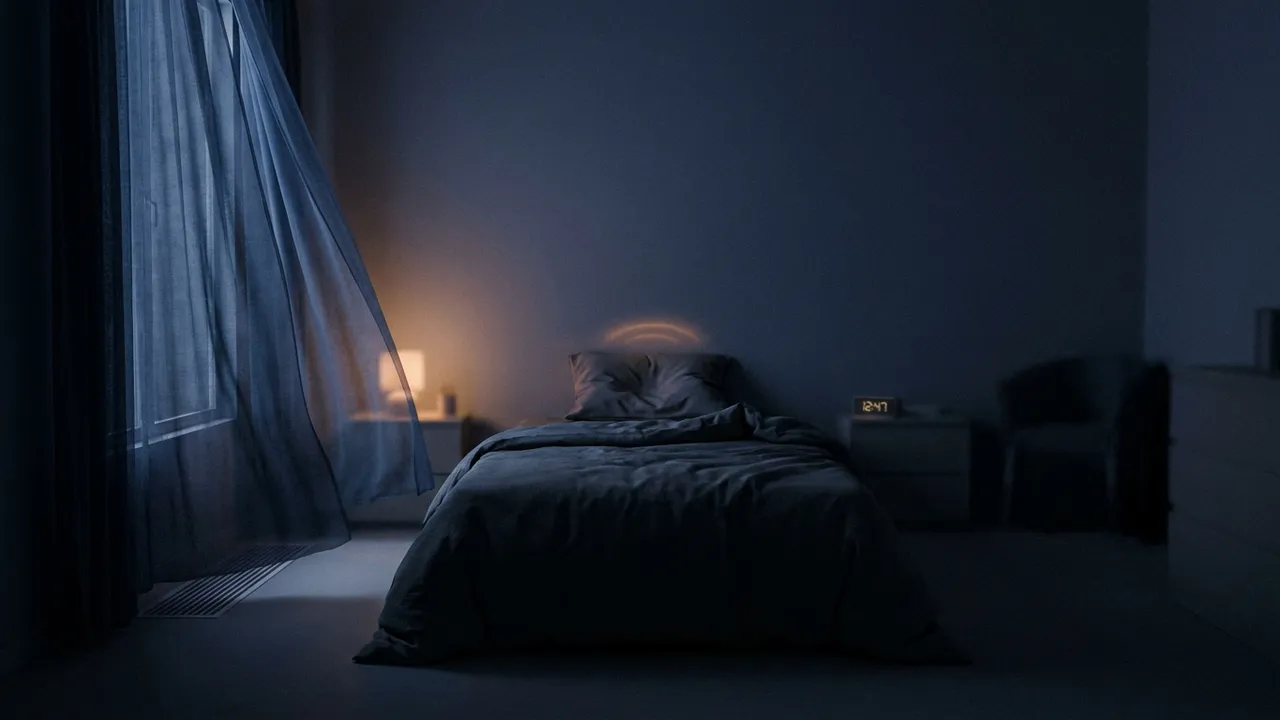

There is a particular kind of night that feels almost insulting.
Your body is exhausted. Your eyes burn. Your shoulders feel heavy. You have wanted your bed for hours.
And then, the moment the room goes quiet, your mind gets busy.
It starts sorting through unfinished parts of the day. The sentence you wish you had not said. The bill. The appointment. A strange look someone gave you at work. You turn your pillow over. You check the time. You do the calculation that almost never helps: if I fall asleep now, I can still get six hours. Five and a half. Five.
This is the tired-but-wired feeling at night.
It is common to feel physically tired while your mind is still alert. That does not tell you one exact cause. Stress, worry, caffeine, irregular timing, pain, medication, sleep loss, and the pressure to fall asleep can all play a part.
The Cruel Joke of Being Exhausted But Awake
It can feel like a betrayal: your body wants rest while your mind keeps working. You may feel tired everywhere and still be unable to settle.

When Your Body Is Done But Your Brain Sits Up
The harder you try to force sleep, the more awake you may feel. Checking the clock, testing whether you are sleepy yet, or worrying about tomorrow can turn bedtime into another task to perform.
The State With a Name: Hyperarousal
Sleep researchers often use the word hyperarousal to describe heightened mental or physical arousal associated with insomnia. It can include racing thoughts, muscle tension, a noticeable heartbeat, or a sense of being unusually alert. But it is a research concept, not a diagnosis you can make from one bad night, and there is no single biological pathway that explains every tired-but-wired experience.
If mental activity is the biggest part of your night, we wrote more about it in why you can't shut your brain off at night.
Why This Happens: Tired and Alert at the Same Time
Alertness Can Outlast the Day
A demanding day can leave you mentally keyed up after the actual demands have ended. Worry, late work, conflict, bright light, caffeine, alcohol, pain, and irregular sleep timing can all affect how easily you wind down. Sometimes the simple fear of another bad night becomes part of the problem too.
None of this means your body is secretly detecting danger or waiting for an "all clear." It means sleep depends on several systems and habits lining up, and sometimes they do not line up neatly.
Cortisol, the HPA Axis, and What We Can Actually Say
Cortisol is one hormone involved in the body's stress response and daily sleep-wake rhythm. It usually follows a circadian pattern, with higher levels around waking and lower levels later in the day. Research on insomnia has found links between stress-system activity and sleep in some groups, but findings are mixed and do not let us infer your cortisol level from the feeling of being wired at night.
That matters because "high cortisol" has become an easy online explanation for almost every restless evening. Sometimes stress is relevant. Sometimes caffeine, timing, illness, medication, pain, anxiety, or another sleep problem is more important. A symptom is not a hormone test.
You may also see the phrase "adrenal fatigue" used online for feeling exhausted and unable to switch off. Adrenal fatigue is not a recognized medical diagnosis. If fatigue or sleep problems are persistent, it is better to discuss them with a clinician than to assume your adrenal glands are the cause.
You Do Not Need a Survival Story to Explain It
It is tempting to explain a restless night with a story about an ancient body standing guard. That image can sound convincing, but it is too broad to explain an individual person's sleep.
A simpler explanation is enough: you can be very sleepy and still have enough mental or physical arousal to delay sleep. That is frustrating, but it does not mean your body has made a survival decision or mistaken your bedroom for a dangerous place.
Sleepiness vs. the Ability to Sleep
The Two Tides of Sleep
One useful model is the two-process model of sleep, first proposed by Alexander Borbély and later refined. It describes two interacting influences: homeostatic sleep pressure, which builds the longer you are awake, and the circadian system, which helps time sleep and wakefulness across the day.
Sleep pressure is why a long day can make your eyes heavy. The circadian system is one reason light exposure and timing matter. These processes interact with many other influences, including stress, behavior, health, and the sleep environment.
When Alertness Competes With Sleepiness
You can have strong sleep pressure and still struggle to fall asleep. Being overtired does not guarantee immediate sleep, especially if you are worried, uncomfortable, stimulated, or watching the clock.
That does not mean an invisible switch is stuck. It simply means the feeling of tiredness and the ability to fall asleep are related but not identical.
Why Trying Harder Can Make Sleep Harder
Sleep is difficult to force. Trying to solve every thought or constantly checking whether a technique is working can keep your attention focused on being awake.
A better goal for the moment may be smaller: reduce stimulation, get comfortable, and give yourself something simple to focus on. For some people, that might be a slow breath. For others, it might be quiet audio, a familiar book, or getting out of bed briefly if wakefulness has become frustrating.
For people with persistent insomnia, CBT-I is the best-supported behavioral treatment. If nighttime alertness feels linked to trauma or ongoing anxiety, professional support may also be useful. You can read more background in the science of nighttime hyper-vigilance.
A Breathing Option: The Physiological Sigh
A Simple Double-Inhale Pattern
The physiological sigh is a double inhale followed by a longer exhale.

People sometimes do a similar pattern spontaneously, including after crying. You can also try it deliberately if it feels comfortable.
What the Research Shows
A 2023 Cell Reports Medicine study compared several five-minute daily breathing practices with mindfulness meditation over one month. The cyclic-sighing group showed a larger increase in positive mood and a larger reduction in resting respiratory rate than the mindfulness group. Both breathwork and mindfulness were associated with improvements in mood and anxiety measures.
That is useful evidence for a brief breathing practice, but it is not proof that a few sighs will treat insomnia or immediately put you to sleep. Breathing exercises are one option, not a nervous-system reset.
It Gives You Something Simple to Do
The practical advantage is that the pattern is simple. You do not have to solve tomorrow while doing it. You can place your attention on one inhale, one small second inhale, and one unhurried exhale.
If it feels pleasant, keep it. If it makes you lightheaded, short of breath, or more anxious, stop and breathe normally. There is no prize for pushing through discomfort.
How to Practice the Physiological Sigh
The Steps: Keep It Simple
Stay in a comfortable position and keep the breath gentle.
Try it like this:
- Inhale through your nose comfortably.
- Before you exhale, take a second smaller inhale.
- Exhale slowly through your mouth without forcing the breath empty.
Then return to normal breathing. If you like, repeat the pattern two or three times.
The aim is not to send your body a biological command. It is simply to try a short, low-effort breathing pattern and notice whether it helps you feel a little less keyed up.
What to Do When Thoughts Return
Thoughts returning does not mean the exercise failed. A breathing practice does not switch thinking off.
You can bring attention back to something neutral: the weight of your arm, the cool edge of the pillowcase, the sound of the room, or the next easy breath. If focusing on your body makes you more anxious, choose an outside sound instead.
And if breathing is not your thing, skip it. A short stretch, a familiar audio track, a few pages of a calm book, or another low-stimulation routine may suit you better.
When Spoken Guidance Feels Easier
When Even a Simple Practice Is Too Much
There are nights when remembering steps feels like work. In that case, spoken instructions can reduce the number of decisions you have to make.
A Voice Can Be an Attention Cue, Not a Person in the Room
A real person can listen, respond, notice distress, and offer human connection. An AI-generated or recorded voice cannot do those things, and it should not pretend to.
What audio can do is give your attention a simple structure: one cue at a time, delivered at a pace you find comfortable. Some people like that. Others prefer silence, music, white noise, meditation, or no audio at all.
A Ritual Is One Option
Tonight is a wellness product built around short, low-light, AI-guided evening rituals. Its voices are carefully crafted and the ritual can be shaped around what you enter, but the AI is not a person, therapist, medical professional, or crisis service. It does not listen or understand in the human sense.
A repeated wind-down routine may help make bedtime feel more predictable. That can include Tonight, meditation, reading, white noise, stretching, or whatever else genuinely helps you wind down. You can read more about repeated routines in on ritual and rhythm.
If you would like to try Tonight, you can download Tonight.
If difficulty falling or staying asleep is persistent, affects your days, or comes with loud snoring, gasping, pauses in breathing, significant pain, or other concerning symptoms, talk with a healthcare professional. Wellness rituals are not a substitute for assessment or treatment.
Related reading: the heart a little too present · quiet loud mind sleep
Frequently asked questions
Why am I so tired but can't sleep?
You can have strong sleep pressure and still struggle to fall asleep. Stress, worry, caffeine, irregular timing, pain, medication, the sleep environment, and the pressure to sleep can all contribute. Feeling tired but alert does not identify one specific nervous-system or hormone problem.
What does the tired but wired feeling mean?
"Tired but wired" simply describes being physically or mentally exhausted while still feeling too alert to settle. Sleep researchers sometimes discuss heightened arousal in insomnia, but the feeling itself has many possible causes and is not a diagnosis.
Can high cortisol at night keep me awake?
Cortisol is involved in stress and follows a daily rhythm, so it can be relevant to sleep. But you cannot tell that your cortisol is high from the feeling of being wired at night, and research does not support treating one restless evening as proof of a cortisol problem. Persistent symptoms are better discussed with a clinician.
How does the physiological sigh help when you are too tired to sleep?
The physiological sigh is a double inhale followed by a longer exhale. A month-long study of five-minute daily breathing practices found benefits for mood and respiratory rate, especially with cyclic sighing, but it did not show that the technique treats insomnia or guarantees sleep. It is a brief option to try if the pattern feels comfortable.