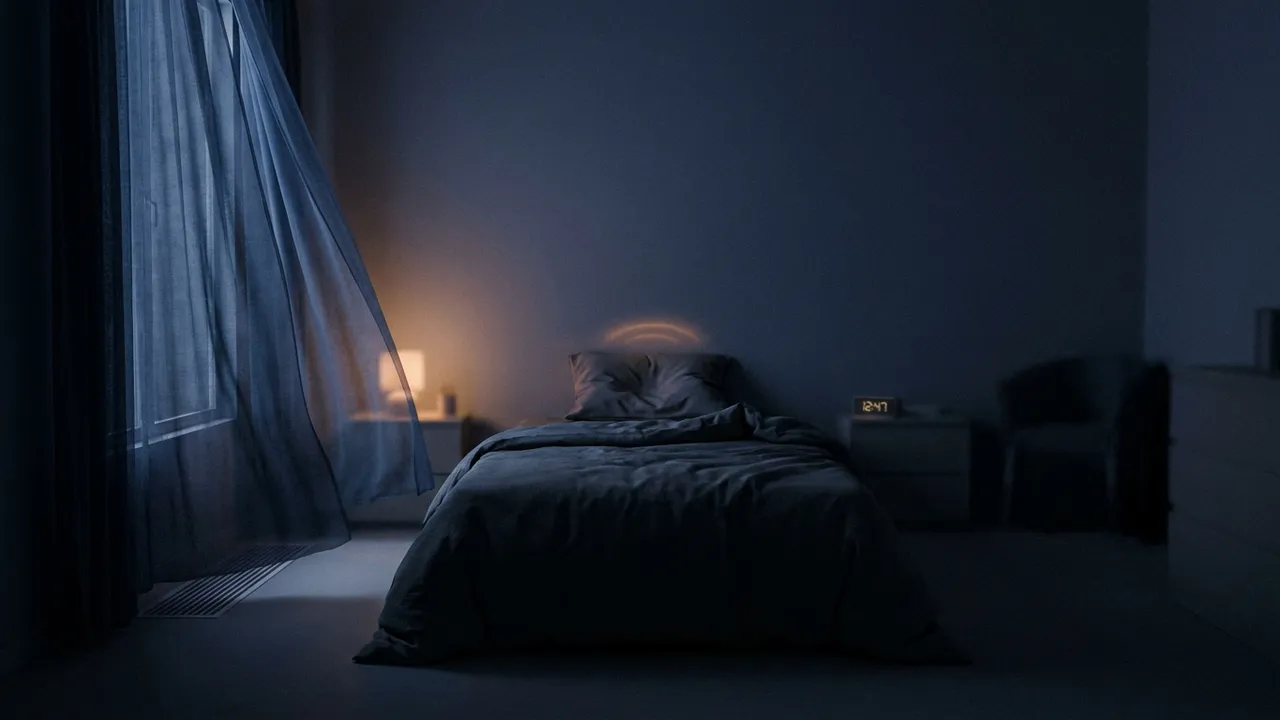

You are exhausted. Your eyes feel heavy. The day has taken enough out of you.
And still, when you get into bed, you feel unusually alert.
"Wired but tired" describes a feeling, not a diagnosis. Stress can be part of it, but so can caffeine, alcohol, late light exposure, pain, medication, a delayed sleep schedule, chronic insomnia, or simply the pressure to fall asleep quickly.
You cannot tell from the feeling alone that cortisol or adrenaline is high, and there is no single "safe-to-rest" signal that switches the body into sleep.
The Exhausting Paradox of Being 'Wired But Tired'
You can feel sleepy and alert at the same time. The need for sleep may be strong while your attention is still caught by thoughts, sensations, light, noise, or the worry that you will not sleep.

What a Wired-But-Tired Night Feels Like
You may feel physically heavy but mentally restless. Your jaw may be tense. Your heartbeat may be easy to notice. Small sounds or textures may seem unusually distracting. You may keep checking how tired you feel and how much sleep time is left.
What 'Tired But Wired' Really Means
It means tiredness and alertness are overlapping. That is all the phrase can tell us.
Sleep pressure, circadian timing, learned bedtime habits, stress, substances, and health all affect sleep. A "wired" feeling does not prove your nervous system is running a safety program or succeeding at staying ready.
If mental replay is the main problem, you may recognize yourself in why you can't shut your brain off at night.
Stress Hormones and the 'Second Wind'

Cortisol, Adrenaline, and the HPA Axis
Cortisol is involved in stress responses and daily timing. It typically rises around waking — the cortisol awakening response — and follows a circadian pattern across the day. Adrenaline is involved in acute responses that can increase heart rate and alertness. The HPA Axis is one system involved in the body's stress response.
Those facts do not mean a wired night is a cortisol or HPA-axis problem. Studies of insomnia and stress biology show group-level associations, not a way to diagnose an individual's hormone state from symptoms in bed.
Why the Day Can Feel Hard to End
Late work, difficult conversations, caregiving, bright light, a busy phone, caffeine, and irregular schedules can all make the end of the day feel abrupt. Some of those factors affect physiology; some simply keep your attention engaged.
If you feel a "second wind," consider timing and behavior before assuming a hormone spike.
Avoid the Fight-or-Flight Story as a Default
The sympathetic nervous system is involved in mobilization, but a restless evening is not evidence that an ancient alarm system has mistaken an email for a predator. Sometimes you are stressed. Sometimes you drank coffee too late. Sometimes your circadian rhythm runs later. Sometimes you are uncomfortable or worried.
The exact cause matters when the problem is persistent, which is why self-diagnosing cortisol or adrenaline is not very useful.
If your heartbeat becomes especially noticeable in bed, see heartbeat loud when trying to sleep.
Caffeine, Alcohol, and the Timing of Your Day
Caffeine commonly has a half-life of several hours, so an afternoon dose can still affect some people late at night. Sensitivity varies widely.
Alcohol may make you sleepy at first but can disrupt sleep later in the night. Research has found effects on sleep architecture, including REM sleep; one review is available here.
Light timing matters too. Bright light late in the evening can shift circadian timing and make sleepiness arrive later. Exercise timing affects people differently; for many, evening exercise is fine, while very intense exercise close to bed can feel activating.
These are useful things to test because they are concrete and changeable.
Why Trying Harder to Relax Can Backfire
Trying to force sleep often turns into monitoring: checking the clock, checking your breathing, checking whether you feel sleepy yet.
When the Bed Becomes a Stage
The more sleep feels like a performance, the more attention you give to being awake. That can increase frustration and conditioned arousal around the bed.
You do not need to explain this as the nervous system interpreting effort as danger. The simpler behavioral loop is enough: more checking means more attention on wakefulness.
Why You Can't Think Your Way to Sleep
You cannot reason yourself into unconsciousness on command. Problem-solving has a place, but bedtime is often a poor time to solve every unfinished issue.
The default mode network is involved in internally focused thought, but it is not a universal bedtime courtroom or a proven cause of rumination. If your mind wanders more when the room is quiet, that ordinary description is enough.
Use Low-Effort, Concrete Actions
Try actions rather than biological messages: lower the light, put away work, adjust the room, stretch if you want, read something familiar, or listen to audio you find calm.
Meditation is another valid option. It is not inherently too cognitive or too demanding for a wired person; fit varies by person and practice.
Low-Stimulation Ways to Wind Down
The parasympathetic nervous system and Vagus Nerve are real parts of autonomic physiology. But it is misleading to say a bedtime technique sends the vagus nerve the message that you are "safe enough now."
Use relaxation practices because they feel helpful, not because they promise to flip a hidden biological switch.
Try a Comfortable Longer Exhale
Slow breathing can influence heart rate and autonomic measures. A review of slow breathing and physiological effects describes evidence across multiple studies.
If you want to try it, keep the breath gentle. For example, inhale for about four counts and exhale for about six. Skip any pause that feels uncomfortable. Stop if you become dizzy, short of breath, or more anxious.
Longer exhalation is an option, not a sleep treatment or a guaranteed parasympathetic "downshift."
Non-Sleep Deep Rest (NSDR): Resting Without Forcing Sleep
"NSDR" is a broad popular label for guided rest practices, often drawing from yoga nidra and body-scan traditions. Research on yoga nidra and wellbeing is interesting but does not establish NSDR as a standard treatment for insomnia.
If guided rest helps you stop trying to force sleep, that can be useful. If chronic insomnia is the problem, CBT-I has much stronger treatment evidence.
When a Meditation Is a Bad Fit
Some meditations may make you more aware of sensations or thoughts. Others may help a lot. If one style makes you more alert, switch styles or stop. That is a preference issue, not proof that meditation "backfires" for wired nervous systems.
If you have strong nighttime watchfulness, the science of nighttime hyper-vigilance discusses the term and its limits.
When It Is Worth Talking to Someone
If difficulty falling or staying asleep happens three or more nights a week for at least three months and affects daytime functioning, it may meet criteria for chronic insomnia disorder. CBT-I is the first-line behavioral treatment.
Also talk with a clinician about loud snoring, gasping, pauses in breathing, severe daytime sleepiness, recurrent palpitations, persistent pain, major mood changes, or sleep problems that began after a medication change.
Tonight is a wellness ritual, not medical treatment, and it does not replace assessment or CBT-I.
Building a Predictable Audio Ritual

Why Predictability Can Help
Behavioral treatments for insomnia use consistent cues and sleep-related habits; the AASM guideline on behavioral and psychological treatments for chronic insomnia covers several evidence-based approaches.
Predictability can reduce decisions and help separate daytime activities from sleep. We do not need to say the nervous system "loves" a sequence or that the body salivates like Pavlov's dog.
What Audio Can Do
Audio can give your attention a simple path without requiring you to keep looking at a screen. An AI-generated voice can deliver paced prompts and content shaped around what you enter.
It cannot stay with you in the human sense, listen, understand, co-regulate, or know whether your sleep problem needs medical care.
Building a Gentle Slope Into Sleep
A small routine might be: finish work, lower the light, put the phone down, choose one quiet activity or audio track, and go to bed when sleepy. If you are awake and frustrated for a while, CBT-I stimulus-control principles may be more useful than adding more relaxation techniques.
Tonight can be one optional part of that routine. It is not better by definition than meditation, reading, music, or another low-stimulation practice. If you want to try it, you can download Tonight.
Related reading: The nervous system likes predictability
Frequently asked questions
Why do I feel tired but can't sleep?
You can be physically tired while still feeling mentally or physically alert. Stress, caffeine, alcohol, late light exposure, pain, medication, circadian timing, insomnia, and the pressure to sleep can all contribute. The feeling does not identify one specific nervous-system or hormone problem.
What does it mean to feel wired but tired?
"Wired but tired" describes being exhausted while still feeling unusually alert or restless. It is a useful description, not a diagnosis. You cannot tell from the sensation alone that cortisol, adrenaline, or the sympathetic nervous system is the cause.
Does high cortisol at night keep you awake?
Cortisol follows a daily rhythm and can be affected by stress, so it can be relevant to sleep. But a wired feeling at bedtime is not a cortisol test. Many other factors can produce the same experience, and persistent symptoms should be assessed rather than assumed to be hormonal.
How do you calm down when you are tired but wired?
Reduce effort and stimulation: lower the light, stop work, adjust the room, and choose one simple activity such as reading, meditation, slow comfortable breathing, stretching, or guided audio. If the problem is chronic or affects daytime functioning, CBT-I or professional assessment may be more useful than adding another relaxation trick.