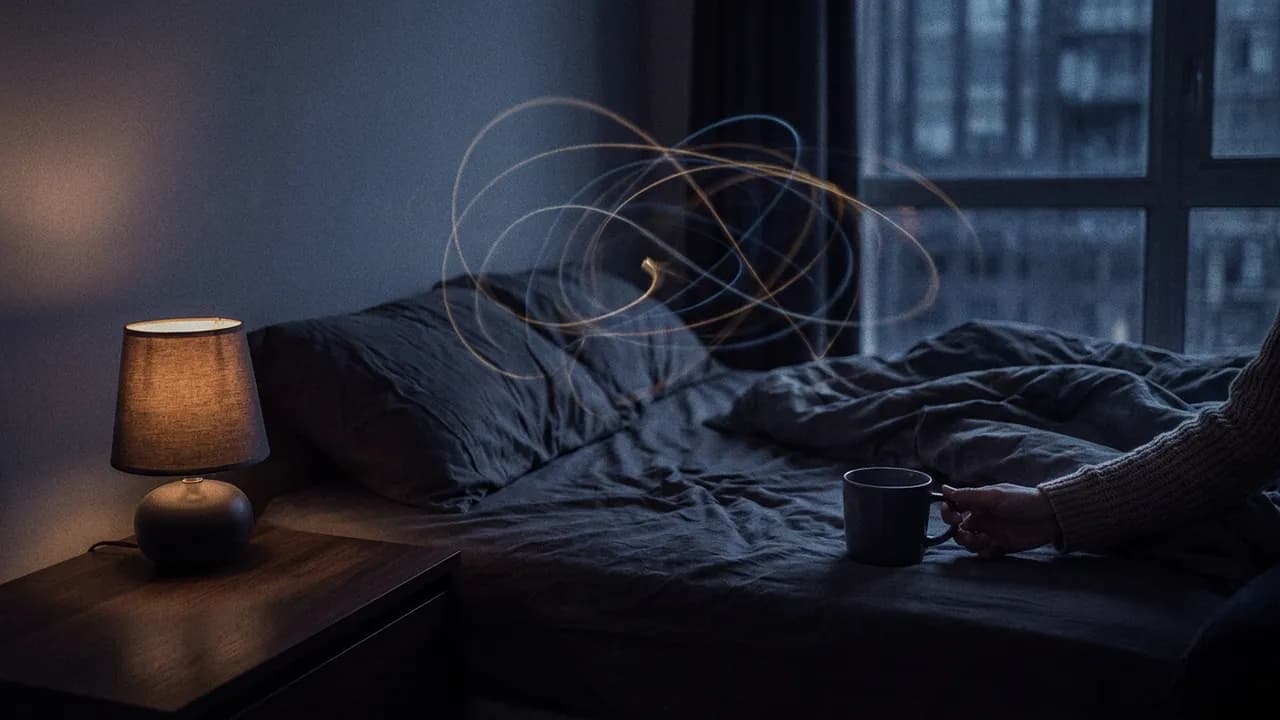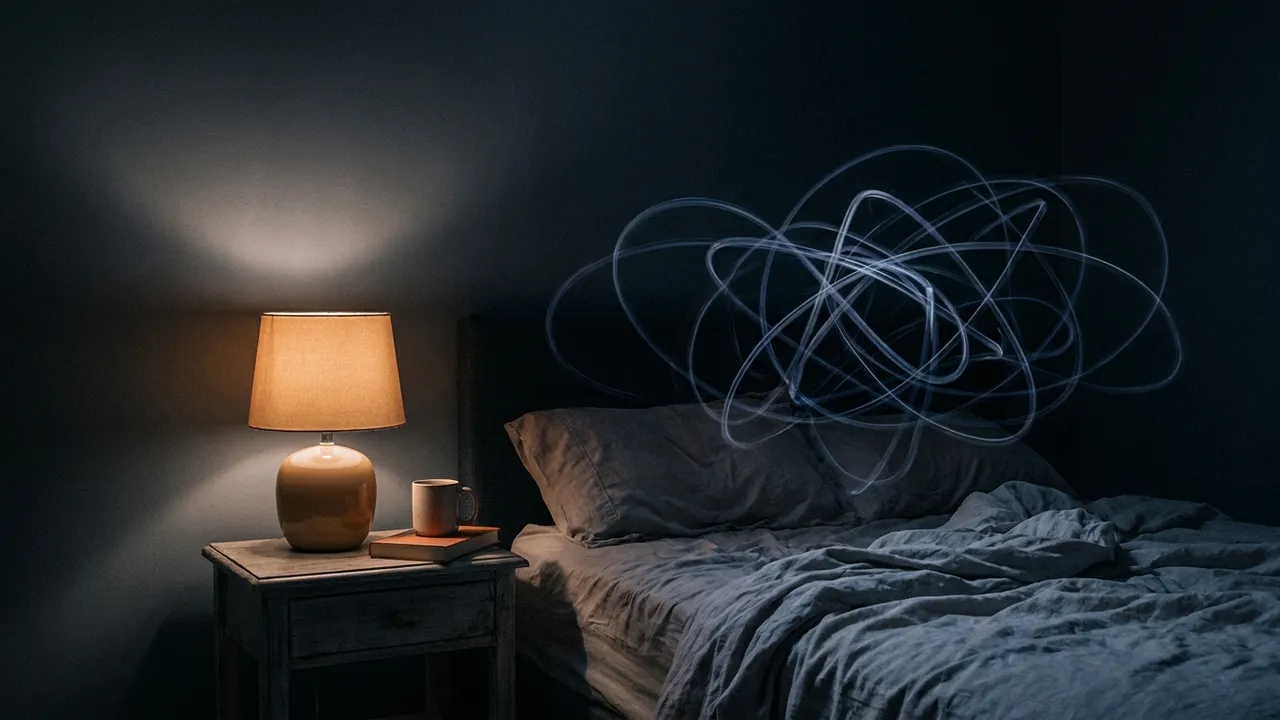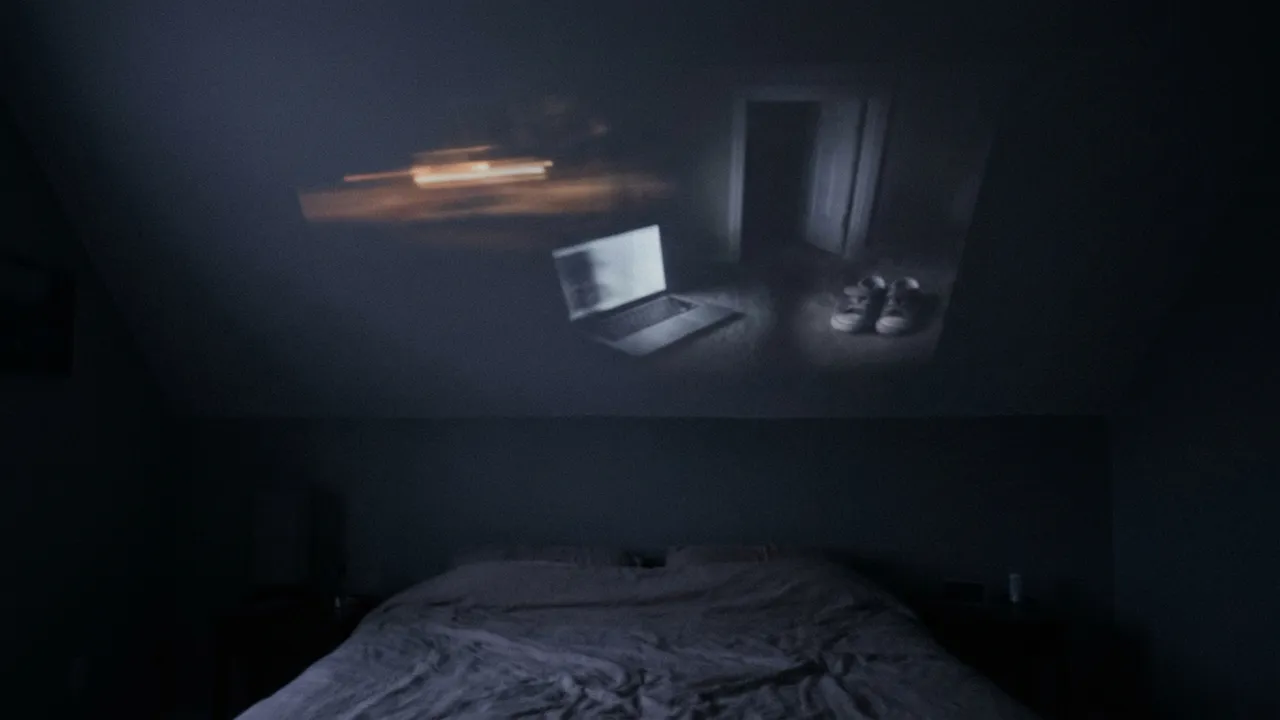
The laptop is closed, but work is still running in your head.
You remember the email you did not answer. A meeting starts replaying. Tomorrow's tasks begin arranging themselves into a list you never asked for.
Work stress can make it harder to fall asleep, but that does not tell you that your nervous system missed a biological "switch-off" signal. Worry, unfinished tasks, late messages, long hours, caffeine, bright screens, and learned bedtime habits can all keep work mentally active after the job itself has stopped.
A simple day-closing routine can help because it gives unfinished work somewhere to go and reduces the number of things you are trying to hold in your head.
Why Work Stress Can Make It Hard to Fall Asleep
Your Attention May Still Be in Work Mode
A demanding day can leave you mentally alert after you stop working. Stress hormones such as cortisol are part of the body's stress response, but feeling keyed up in bed does not tell you that cortisol is high or that one hormone is causing the problem.

The more direct contributors are often visible: a late Slack message, a difficult conversation, an unfinished task, a laptop used until bedtime, or the expectation that you should solve tomorrow before you sleep tonight.
Why 'Just Relax' Is Not Very Useful
You cannot switch off worry by ordering yourself to relax. It is often easier to change what you are doing with the worry: capture it, decide whether action can wait, and stop feeding it with new work input.
The goal is not to prove to your body that you are safe. It is to give the workday a practical ending.
The Endless 'One More Thing' Cycle
The Texture of Work Thoughts at Night
Work thoughts are often small and specific.

A number you forgot to check. A message whose tone you are unsure about. A sentence you wish you had phrased differently. A task that is nearly finished but not quite.
When those thoughts keep returning, it can feel as if continuing to think is a form of responsibility. Usually it is not moving the work forward.
Unfinished Tasks Can Stay Mentally Active
The Zeigarnik Effect is often used to describe the tendency for unfinished activities to remain mentally accessible. The evidence around the classic effect is more complicated than the popular one-line version, so it should not be treated as a universal law.
A useful sleep-specific study is more concrete: in a small laboratory experiment, participants who spent five minutes writing a specific to-do list for the next few days fell asleep faster on average than participants who wrote about completed activities. That does not prove a bedtime list treats insomnia, but it supports the idea that writing unfinished tasks down can be worth trying.
Not Denial, but Containment
A closing routine does not require pretending the work is fine. A deadline can still be real. A conflict can still need repair.
The point is to separate "this matters" from "I must keep rehearsing it in bed."
If your mind becomes generally busy once the room is quiet, why you can't shut your brain off at night covers that broader pattern.
Why Your Brain Thinks It's Still on the Clock
Psychological Detachment From Work
Work-recovery research uses the term psychological detachment for mentally disengaging from work during non-work time. It is associated with recovery and wellbeing, although the exact relationship varies by job and person.
Modern work can make detachment harder. The desk may be in the bedroom. The phone may carry work messages all evening. Remote work can remove the commute that once created a natural boundary.
You Do Not Need a Cortisol–Melatonin–DMN Story
It is possible for work stress to affect sleep physiology. But you cannot look at a night of work rumination and conclude that cortisol is elevated, melatonin is being blocked, or the Default Mode Network is causing the thoughts.
A simpler explanation is enough: work remains cognitively and behaviorally active when you want the workday to be over.
Your Bed Is Not Your Second Office
CBT-I often works with the learned association between bed and wakefulness. If you repeatedly answer work messages, plan, worry, or spend long periods frustrated in bed, the bed can become a cue for being awake rather than sleeping.
That is why moving work out of bed is useful when possible. It is a behavioral boundary, not a nervous-system message.
Creating a 'Third Space': Your Bridge From Work to Rest
Create a Transition in Time
You may not have a commute or separate office. You can still create ten minutes in which work has ended and the next part of your life has not started yet.
That time can be very ordinary: close the laptop, write tomorrow's first task, change clothes, wash up, walk around the block, make food, or sit somewhere that is not your desk.
A Bridge From Work to Personal Time
Do not make the transition another performance. You do not need to become perfectly calm.
A useful sentence is practical: "I have written down what needs attention. I will come back to it tomorrow."
Then do something that is clearly not work.
Why Repetition Can Help
Repeating the same few steps reduces decision-making. That is enough to justify a ritual; we do not need to say the nervous system learns through an ancient language of thresholds or safety.
For more on repeated routines, on ritual and rhythm explores the idea.
A Simple Ritual for Closing the Day
The Three-Step Day-Closing Ritual
Try this before you get into bed. Five or ten minutes is enough.
Capture unfinished work. Write the tasks and worries that keep returning. Beside an actionable item, add the next small step and, if useful, when you will do it. If something is only worry, label it as worry rather than inventing a task.
Change the context. Close the laptop. Put work notifications on pause if your job allows it. Change clothes, wash your face, lower the lights, or move to another room. These are practical context changes, not vagus-nerve signals.
Enter personal time deliberately. Choose one ordinary activity that is not about output: food, a shower, a walk, reading, music, meditation, stretching, talking to someone, or quiet audio.
If slow breathing feels comfortable, you can include it. It is an option, not proof that your body has switched into a specific autonomic state.
Open, Capture, Close
If a work thought returns, you can add one line to the list and close it again. The aim is not to make thoughts disappear. It is to stop using memory as your only task manager at midnight.
Letting a Ritual Reduce the Decisions
When Do I Get to Put It Down?
Caring about your work and stopping work are compatible. If the job has no natural boundary, you may need to create one deliberately.
That can be harder in jobs with on-call responsibilities, caregiving, emergencies, or unpredictable shifts. In those cases, the goal is not a perfect "off" state. It may simply be reducing unnecessary work input when you are actually off duty.
Why a Routine Can Be Easier Than Another Tip
A routine removes choices. The same notebook, the same notification setting, the same low light, the same next activity. Familiarity can make the transition easier without implying that the body has learned to "stand down" from vigilance.
Tonight can be one optional part of that routine. It is an AI-guided wellness product with carefully crafted voices and low-light audio. The AI does not listen, understand your job, provide human company, or treat anxiety or insomnia. It is also not inherently better than meditation, reading, music, or silence.
If persistent work anxiety or insomnia is affecting your days, CBT-I, therapy, workplace changes, or medical assessment may be more appropriate than another wind-down tool.
If you want a structured audio ritual after work is closed, you can download Tonight.
Related reading: your brain drafts emails you will never send. It rehearses explanations. · de-stress from work before bed
Frequently asked questions
How do I fall asleep when I'm stressed about work?
Try giving work a clear stopping point before you get into bed. Write down unfinished tasks and their next steps, close work apps or notifications when you are off duty, change context, and choose one quiet non-work activity. The aim is not to force calm but to stop carrying tomorrow's task list only in your head.
Why can't I sleep when I keep thinking about work?
Work can stay mentally active because tasks are unfinished, a conversation is unresolved, work messages continue into the evening, or the bed has become a place where you plan and worry. Stress biology may play a part, but the symptom does not tell you that cortisol is high or that your nervous system missed a safety signal.
What is a day-closing ritual?
A day-closing ritual is a short repeated sequence that separates work from personal time. It might include writing tomorrow's tasks, closing the laptop, changing clothes or lighting, and choosing one non-work activity. Its value is practical: fewer open loops and fewer decisions at the end of the day.
How do I switch off from work anxiety at night?
You may not be able to switch anxiety off on command. Instead, reduce what keeps it active: capture unfinished tasks, stop new work input, avoid doing work in bed, and move into a simple wind-down. If work anxiety or insomnia is persistent or significantly affects daily life, professional support can help.